Of all the compatibility factors checked during kundali matching, Nadi Dosha is often the one that causes the most concern. It carries the highest weightage in the Ashta Koota system — 8 out of 36 points — and is traditionally associated with health problems, difficulties with children, and marital discord according to classical Vedic astrology texts. Many families call off alliances the moment Nadi Dosha is detected.
But when does Nadi Dosha actually apply, and are there exceptions that nullify it? This guide covers the three Nadi types, conditions that trigger Nadi Dosha, classical exceptions, and proven remedies.
What is Nadi?
In Vedic astrology, the 27 Nakshatras (birth stars) are divided into three groups called Nadis, each corresponding to one of the three doshas in Ayurveda:
| Nadi | Dosha | Meaning | Nakshatras |
|---|---|---|---|
| Aadi Nadi | Vata | Wind / Air | Ashwini, Ardra, Punarvasu, Uttara Phalguni, Hasta, Jyeshtha, Moola, Shatabhisha, Poorva Bhadrapada |
| Madhya Nadi | Pitta | Fire / Bile | Bharani, Mrigashira, Pushya, Poorva Phalguni, Chitra, Anuradha, Poorva Ashadha, Dhanishtha, Uttara Bhadrapada |
| Antya Nadi | Kapha | Water / Phlegm | Krittika, Rohini, Ashlesha, Magha, Swati, Vishakha, Uttara Ashadha, Shravana, Revati |
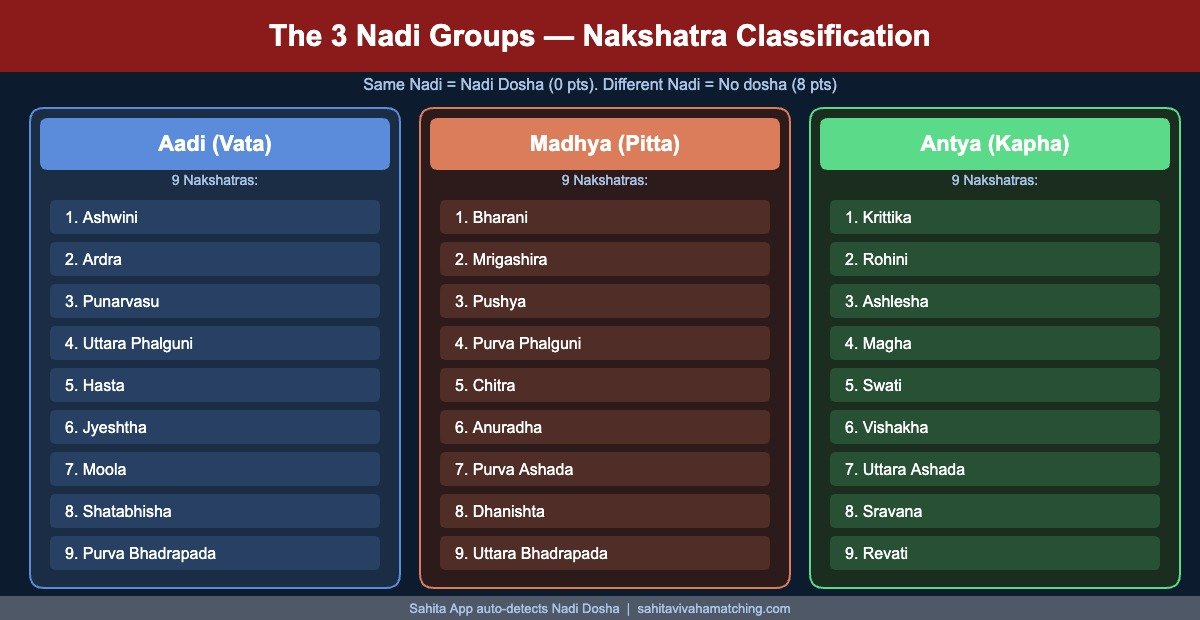
Every person’s birth Nakshatra falls into one of these three Nadis. If both the bride and groom have the same Nadi, it is called Nadi Dosha (or Nadi Kuta Dosha).
What Causes Nadi Dosha?
This dosha occurs when both partners share the same Nadi — both Aadi, both Madhya, or both Antya. The logic in Vedic astrology is that two people with the same Nadi have identical elemental constitutions. Rather than complementing each other, they amplify the same qualities — leading to imbalance in the relationship.
To check whether it applies:
- Find the bride’s birth Nakshatra and identify her Nadi
- Find the groom’s birth Nakshatra and identify his Nadi
- If both Nadis are the same — Nadi Dosha is present
- If the Nadis are different — full 8 points are scored in Ashta Koota
The Sahita app detects this dosha automatically when you enter the birth details of both partners.
Effects of Nadi Dosha
Classical Vedic texts describe the effects in three categories depending on which Nadi both partners share:
Aadi Nadi Dosha (both in Vata Nadi):
Associated with health problems related to the nervous system and circulation. Classical texts link this with difficulties conceiving and potential conflict in the early years of marriage.
Madhya Nadi Dosha (both in Pitta Nadi):
Associated with emotional intensity, ego clashes, and friction in the relationship. Both partners may be strong-willed, leading to recurring disagreements.
Antya Nadi Dosha (both in Kapha Nadi):
Associated with lethargy, financial challenges, and slow-moving problems that build up over time. Some texts link this with difficulties related to children’s health.
Important caveat: These are classical descriptions from traditional texts. Many astrologers take a nuanced view — noting that Nadi Dosha effects are not deterministic and depend heavily on the complete horoscope, planetary periods (dashas), and the individual’s overall chart strength. Modern Jyotishis often use Nadi Dosha as one signal among many, rather than a decisive yes/no.
Nadi Dosha Exceptions — When Is It Cancelled?
This is the most important section for families concerned about Nadi Dosha. Classical Vedic astrology recognises several Nadi Dosha Parihar (exceptions and cancellations). When any of these conditions apply, the Dosha is considered cancelled or significantly reduced in severity.
Exception 1: Different Rashi, Same Nadi
If both partners have the same Nadi but belong to different Moon signs (Rashis), many traditions consider this a partial or full cancellation. The reasoning: the similarity in Nadi is offset by the differences in Rashi, which indicates sufficiently different life paths and constitutions.
Exception 2: Same Rashi, Different Nakshatra
If both partners share the same Rashi (Moon sign) but have different Nakshatras within that Rashi, the dosha is typically cancelled. Different Nakshatras within the same Rashi still represent meaningfully different natures.
Exception 3: Same Nakshatra, Different Pada
Every Nakshatra is divided into four quarters (Padas). If both partners share the same Nakshatra but are in different Padas, many astrologers treat this as a cancellation of Nadi Dosha — the energy within the Nakshatra is expressed differently enough to nullify the concern.
Exception 4: Lord of Nadi Nakshatra Is the Same Planet
In some traditional assessments, if the ruling planet (Nakshatra lord) of both partners’ Nakshatras is the same, this forms a counterbalancing influence. This is a less universally accepted exception and varies by school of thought.
Exception 5: Benefic Influence of Jupiter or Venus
Some Jyotishis consider it significantly reduced when Jupiter (Guru) or Venus (Shukra) is strongly placed in both charts and aspects the relevant houses. This is a chart-level assessment that goes beyond the Ashta Koota system.
What If Nadi Dosha Cannot Be Cancelled?
When Nadi Dosha is clearly present and no exception applies, traditional Vedic astrology prescribes remedies to reduce its effects. These remedies are not guarantees, but they are widely practiced by families and recommended by Jyotishis:
Remedy 1: Nadi Dosha Nivaran Puja
A specific yajna (fire ritual) performed by a qualified Brahmin priest, dedicated to Lord Shiva and the Navagrahas. This is the most commonly recommended remedy. The puja typically includes chanting of specific mantras and offering of designated materials.
Remedy 2: Mahamrityunjaya Mantra
Regular recitation of the Mahamrityunjaya Mantra (OM Tryambakam Yajamahe…) is recommended — particularly by the groom — as a protective mantra against health-related effects of Nadi Dosha. 108 repetitions daily for a set period before the wedding is a common practice.
Remedy 3: Donation and Charity
Donating gold, silver, or cloth to a temple or to a qualified Brahmin is a traditional Vedic remedy for Dosha mitigation. The specific items vary based on the type of Nadi Dosha (Aadi, Madhya, or Antya) and the family’s tradition.
Remedy 4: Wearing Gemstones
Based on the overall chart, a Jyotishi may recommend specific gemstones to strengthen protective planets. This is a personalised remedy that requires a full chart reading rather than a general prescription.
Nadi Dosha vs Bhakut Dosha — What’s More Serious?
Both Nadi Dosha and Bhakut Dosha are considered Maha Doshas in the Ashta Koota system because of their high weightage (8 and 7 points respectively). Here is a quick comparison:
| Factor | Nadi Dosha | Bhakut Dosha |
|---|---|---|
| Points lost | 8 | 7 |
| Based on | Nakshatra (birth star) | Rashi (Moon sign) |
| Primary concern | Health and progeny | Emotional bond and finances |
| Exceptions available | Yes (multiple) | Yes |
| Severity if uncancelled | High | High |
Both Doshas should be checked and evaluated for cancellation before a final compatibility verdict is reached.
How Sahita App Detects Nadi Dosha
When you enter the birth details of both partners in the Sahita app, the following happens automatically:
- The app calculates the birth Nakshatra for both individuals from their date, time, and place of birth.
- It identifies the Nadi (Aadi, Madhya, or Antya) for each Nakshatra.
- It checks whether both Nadis are the same.
- If Nadi Dosha is present, the app flags it clearly in the results.
- It also checks applicable exceptions — such as different Rashi or same Nakshatra with different Pada — and indicates if the Dosha is cancelled.
This means you get not just a “Dosha present” flag but also context on whether exceptions apply — all within the free report. For a complete Dosha assessment including remedies, the premium report provides a detailed PDF you can share with a family pandit.
Summary
Nadi Dosha is triggered when both partners share the same Nadi — Aadi, Madhya, or Antya — based on their birth Nakshatra. It carries the highest weight in the Ashta Koota system (8 points) and is associated with health and progeny concerns in classical Vedic texts. However, several classical exceptions can cancel or reduce Nadi Dosha — including different Rashi, different Nakshatra, or different Pada. When no exception applies, traditional Vedic remedies including Nadi Dosha Nivaran Puja and Mahamrityunjaya Mantra recitation are recommended.
The Sahita app detects Nadi Dosha automatically and checks for applicable exceptions. Download free on Android.
Also read: What is Ashta Koota Matching? | Guna Milan vs Mangala Dosha | 36 Guna Milan Score Guide
Leave a Reply to ಅಷ್ಟ ಕೂಟ ವಿವಾಹ ಹೊಂದಾಣಿಕೆ | 8 Koota Kundali Matching Kannada — Sahita Cancel reply