When two families sit down to evaluate a marriage alliance, the first step in traditional Hindu practice is comparing birth charts. At the heart of this process is Ashta Koota matching — an ancient Vedic astrology system that assesses marriage compatibility across eight specific parameters. The word Ashta means eight, and Koota means compatibility point — forming a structured scoring system with a maximum of 36 Gunas.
FREE TOOL · NO LOGIN · WORKS OFFLINE
Match your kundalis free — right now. Full 36 Guna Ashta Koota with all 8 kootas and Manglik for both partners, computed in your browser. Nothing uploaded.
Run the free kundali match →This guide explains all eight kootas, how the Ashta Koota matching score works, what it means for your marriage alliance, and how the Sahita app calculates it accurately from both partners’ birth details.
Introduction
When two families come together to discuss a marriage alliance, the first thing a traditional Hindu family typically does is compare the horoscopes. At the heart of this process is Ashta Koota matching — an ancient Vedic system that evaluates marriage compatibility across eight different parameters.
The word “Ashta” means eight, and “Koota” means group or point. Together, Ashta Koota matching is a structured scoring system that assigns points to eight areas of compatibility between two birth charts. The maximum possible score is 36 Gunas, and the system is designed to assess whether two individuals are well-matched for a long, harmonious marriage.
This guide explains all eight kootas, how the scoring works, what your Guna score means, and how tools like the Sahita app calculate it accurately using just the birth details of both partners.
What is the Ashta Koota System?
Ashta Koota matching is based on the Nakshatra (birth star) of both the bride and groom. The Nakshatra is determined from the Moon’s position at the time of birth. This is why kundali matching for marriage is sometimes called Nakshatra porutham in South India or Nakshatramilan in other traditions.
Each of the eight kootas tests a specific dimension of compatibility — from basic temperament to sexual harmony, financial stability, and health of children. The system comes from classical texts including the Brihat Parashara Hora Shastra and Muhurta Chintamani and has been used by Vedic astrologers for centuries.
The 8 Kootas — Complete Breakdown
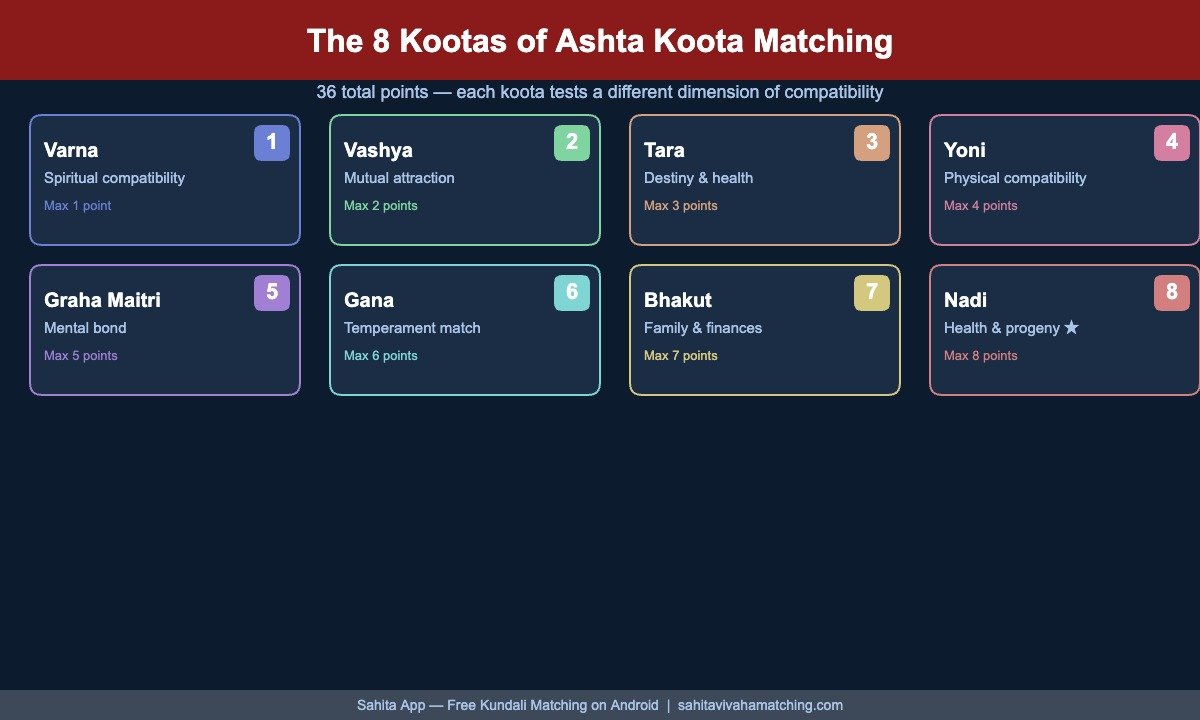
The table below shows each koota, its maximum points, and what it measures.
| # | Koota Name | Max Points | What It Measures |
|---|---|---|---|
| 1 | Varna | 1 | Spiritual compatibility and ego levels |
| 2 | Vashya | 2 | Mutual control, attraction, and dominance |
| 3 | Tara | 3 | Destiny compatibility and long-term health/fortune |
| 4 | Yoni | 4 | Physical and sexual compatibility |
| 5 | Graha Maitri | 5 | Mental compatibility and friendship between Moon signs |
| 6 | Gana | 6 | Temperament and nature (Deva, Manushya, or Rakshasa) |
| 7 | Bhakut | 7 | Emotional compatibility and family well-being |
| 8 | Nadi | 8 | Health compatibility and progeny (childbearing) |
| Total | 36 |
Detailed Explanation of Each Koota
1. Varna (1 point)
Varna represents the spiritual or psychological nature of a person based on their Nakshatra. There are four Varna types — Brahmin, Kshatriya, Vaishya, and Shudra — which in this context represent levels of spiritual development rather than caste categories. In Ashta Koota matching, the groom’s Varna should ideally be equal to or higher than the bride’s for full points. Same Varna scores 1 point; a mismatch scores 0.
2. Vashya (2 points)
Vashya tests the natural affinity and mutual influence between two partners. The 12 Rashis (zodiac signs) are grouped into five categories: Manav (human), Chatushpad (quadruped), Jalachara (aquatic), Vanchar (wild), and Keeta (insects). Full points (2) are scored when the signs have strong mutual control; partial points (1) when there is one-sided influence; 0 when there is no connection.
3. Tara (3 points)
Tara (or Dina) koota examines the relationship between the Nakshatras of the bride and groom in terms of long-term fortune and health. The Nakshatra of the groom is counted from the bride’s Nakshatra, and the result (divided by 9) determines the Tara score. Odd remainders are considered auspicious; even ones inauspicious. This koota is particularly linked to the longevity and health of both partners after marriage.
4. Yoni (4 points)
Yoni koota assesses physical and sexual compatibility. Each Nakshatra is assigned a symbolic animal — such as horse, elephant, sheep, or serpent — and compatibility is determined by how these animals relate to each other in nature. Friendly animals score 4 points; neutral pairings score 2–3; hostile pairings score 0–1. A poor Yoni score can indicate fundamental physical incompatibility between partners.
5. Graha Maitri (5 points)
This koota measures the compatibility of the ruling planets (lords) of the Moon signs (Rashis) of both partners. If the two planetary lords are natural friends, the couple is likely to have a harmonious mental connection and mutual understanding. Friendly lord pairs score 5 points; neutral pairs score 3–4; enemy pairs score 0–1. Graha Maitri is considered one of the most important kootas for a successful long-term marriage.
6. Gana (6 points)
Gana koota classifies each Nakshatra into one of three categories — Deva (divine/spiritual), Manushya (human), and Rakshasa (fierce/intense). Ideally, both partners should belong to the same Gana. Two Devas or two Manushyas together score 6 points. A Deva and Manushya match may score partial points. Deva and Rakshasa is generally considered an incompatible match and scores 0. This koota reflects fundamental differences in outlook, temperament, and lifestyle.
7. Bhakut (7 points)
Bhakut (also written Bhakoot) is one of the highest-weighted kootas, carrying 7 points. It tests the emotional and relational compatibility between the Moon signs of the couple. The calculation involves the relative position of the two Rashis. Certain combinations — like 6-8 (Shad-Ashtaka), 5-9, or 2-12 positions — are considered inauspicious and may indicate emotional distance, financial troubles, or conflict. A compatible Bhakut scores the full 7 points; an inauspicious one scores 0.
8. Nadi (8 points)
Nadi carries the maximum weight in the entire system — 8 points — making it the most important koota. Each Nakshatra belongs to one of three Nadis: Aadi (Vata), Madhya (Pitta), or Antya (Kapha). If both partners belong to the same Nadi, it is called Nadi Dosha and scores 0 points. Different Nadis score the full 8 points. Nadi Dosha is traditionally considered a serious incompatibility, linked to health of offspring and marital harmony, though certain exceptions (Nadi Dosha Parihar) can nullify it.
What Does Your Total Guna Score Mean?
After adding up the points from all 8 kootas, you get a total score between 0 and 36. Here is how to interpret it:
| Score Range | Interpretation | Recommendation |
|---|---|---|
| 0 – 17 | Poor compatibility | Marriage generally not recommended without deeper analysis |
| 18 – 24 | Acceptable compatibility | Proceed with caution; check for Doshas |
| 25 – 32 | Good compatibility | Recommended; strong foundation for marriage |
| 33 – 36 | Excellent compatibility | Ideal match; very auspicious |
It is important to understand that the total score is not the only factor. Even a score above 18 may be reconsidered if there is an uncancelled Nadi Dosha, Bhakut Dosha, or Mangala Dosha present. Conversely, a score slightly below 18 may still be acceptable if all eight individual kootas are analysed carefully and no major Dosha is detected.
Important Doshas to Check Alongside Guna Score
Even when the Guna score is satisfactory, traditional Vedic astrologers check for these specific issues:
How Does Sahita App Calculate Ashta Koota Matching?
The Sahita app performs the full Ashta Koota analysis automatically using the birth details of both partners. Here is what you need to enter:
- Full name (used for display; Nakshatra is derived from date and time of birth)
- Date of birth
- Time of birth (as accurate as possible)
- Place of birth
From this information, Sahita calculates the Nakshatra, Rashi (Moon sign), and Lagna (Ascendant) for both individuals. It then runs all 8 koota calculations using the classical tables from Vedic astrology and produces a final Guna score with a detailed breakdown of each koota — showing how many points were scored and why.
Sahita also automatically flags Nadi Dosha and Mangala Dosha if present, and explains whether any exceptions or cancellations apply. The report can be shared via WhatsApp or saved as a PDF.
Ashta Koota vs Other Matching Systems
While Ashta Koota is the most widely used system in North and South India, there are regional variations worth knowing:
Summary
Ashta Koota matching is a structured, 8-point Vedic system that evaluates marriage compatibility across temperament, health, emotional bond, physical harmony, and more. A total score of 36 Gunas represents the maximum; 18 and above is the minimum generally recommended threshold for marriage. However, individual koota scores and the presence of Doshas must also be reviewed carefully — the total score alone does not tell the full story.
The Sahita app automates this entire process — from Nakshatra derivation to full koota scoring and Dosha detection — giving you an accurate, detailed kundali matching report in seconds. Free to download on Android.
Also read: 36 Guna Milan — How Many Gunas Are Needed for Marriage? | What is Nadi Dosha? | Guna Milan vs Mangala Dosha

6 thoughts on “What is Ashta Koota Matching? Complete Guide to 8 Kootas in Vedic Astrology”