When families assess a marriage alliance through Vedic astrology, two factors come up more than any others. The comparison of Guna Milan vs Mangala Dosha — which matters more, and what to do when one is favourable and the other is not — is one of the most common points of confusion in Vedic marriage matching.
FREE TOOL · NO LOGIN · WORKS OFFLINE
Check if you are Manglik in 10 seconds. Mars from Lagna, Moon and Venus side by side, with the cancellation rule that applies — even without an exact birth time.
Open the free Manglik calculator →Guna Milan and Mangala Dosha are fundamentally different assessments, drawn from different parts of the birth chart. Understanding Guna Milan vs Mangala Dosha correctly is essential for making informed decisions about a marriage alliance. This guide explains both and shows how to use them together.
What is Guna Milan?
Guna Milan (also called Ashta Koota Milan or Kundali Milan) is a Nakshatra-based compatibility system. It compares the birth Nakshatras (Moon stars) of the bride and groom across eight parameters — Varna, Vashya, Tara, Yoni, Graha Maitri, Gana, Bhakut, and Nadi — and produces a total score out of 36.
The system is entirely based on the position of the Moon in both charts. The Moon sign (Rashi) and Nakshatra are the only inputs needed.
Key features of Guna Milan:
- Evaluates 8 different areas of compatibility
- Produces a score from 0 to 36 (18+ is the recommended minimum)
- Based solely on Nakshatra and Rashi (Moon position)
- Does not consider the position of any other planet
- Assesses long-term compatibility, emotional bond, and physical harmony
- Can flag Doshas within its own system (Nadi Dosha, Bhakut Dosha, Gana Dosha)
What is Mangala Dosha?
Mangala Dosha (also called Mangal Dosh, Kuja Dosha, or Chevvai Dosham) is an entirely different kind of assessment. It is not part of the Ashta Koota system. Instead, it is a planet placement analysis — specifically looking at where Mars (Mangal/Kuja) sits in the birth chart.
Mangala Dosha occurs when Mars is placed in the 1st, 2nd, 4th, 7th, 8th, or 12th house of the natal horoscope. (Some traditions include only 5 houses; others use 7. The most widely used list includes all six positions above.)
Key features of Mangala Dosha:
- Based on the position of Mars in the birth chart
- Assessed in the Lagna chart (and sometimes Chandra and Navamsha charts)
- Is a chart-level factor — not connected to Nakshatra or Rashi
- Traditionally associated with marital conflict, health issues, and difficulties in married life
- Affects each partner’s chart independently — one or both partners may have it
Guna Milan vs Mangala Dosha: Nakshatra vs Planetary Position
This is the most important distinction to understand:
| Guna Milan | Mangala Dosha | |
|---|---|---|
| Based on | Nakshatra (Moon position) | Mars house placement |
| System | Ashta Koota (8 parameters) | Single planet analysis |
| Score | 0–36 points | Present / Absent / Cancelled |
| Checks | Both charts together | Each chart independently |
| What it measures | Overall compatibility | Mars-related risk factors |
| Part of Ashta Koota? | Yes — it IS the Ashta Koota | No — separate from Ashta Koota |
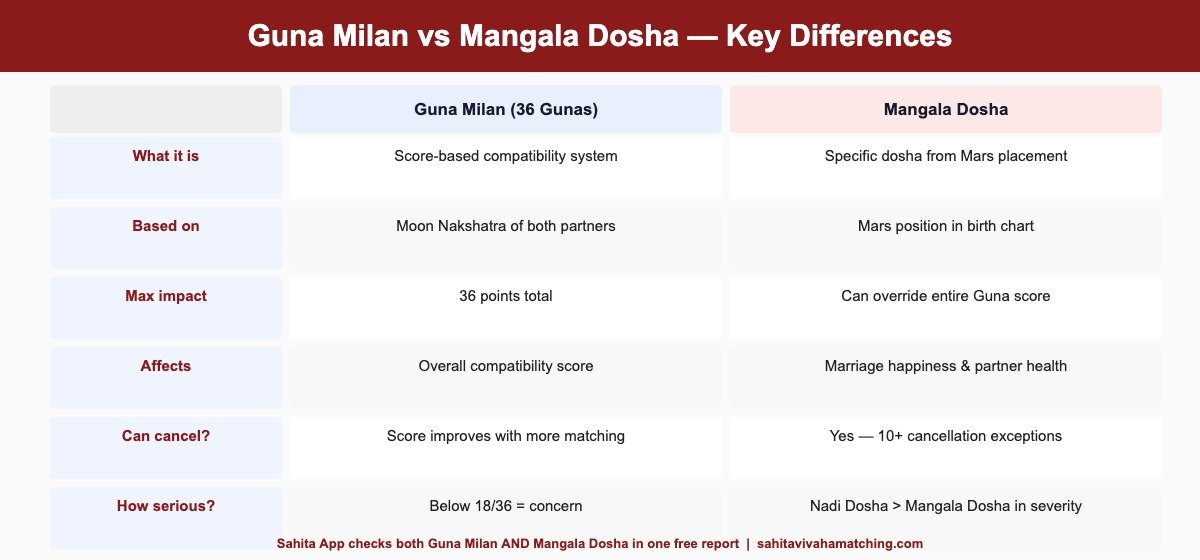
Because they draw from different parts of the chart and measure different things, a good Guna score does not neutralise Mangala Dosha, and Mangala Dosha does not directly affect the Guna score.
Which Takes Priority?
Understanding guna milan vs mangala dosha helps families make better decisions. Both guna milan vs mangala dosha checks are essential — Neither takes absolute priority over the other. They assess different risks and should both be evaluated for a complete picture. Here is the practical approach most experienced Jyotishis recommend:
Step 1: Run Guna Milan first.
This gives you the broad compatibility picture. A score below 18 is a red flag regardless of Mangala Dosha. A score of 25+ indicates a broadly compatible alliance.
Step 2: Check for Doshas within Guna Milan.
Specifically check: Nadi Dosha (8 pts), Bhakut Dosha (7 pts), and Gana Dosha (6 pts). These can significantly impact an otherwise good total score.
Step 3: Check Mangala Dosha in both charts independently.
Does the bride have Mangala Dosha? Does the groom? If only one partner has it and the other does not, traditional astrology considers it problematic. If both have it, most traditions consider this a cancellation — the Mars energy balances out.
Step 4: Check for Mangala Dosha cancellations.
There are several well-recognised conditions that cancel Mangala Dosha (described below). Always check cancellation before treating the Dosha as active.
Mangala Dosha Cancellations
Mangala Dosha has a rich set of cancellation conditions in classical Vedic astrology:
1. Both partners have Mangala Dosha: The most widely accepted cancellation. If both the bride and groom have Mars in a Dosha-causing house, the Dosha is considered self-cancelling. The logic: both bring the same Mars intensity, so there is no imbalance.
2. Mars is in its own sign or exalted: If Mars is in Aries or Scorpio (own signs) or Capricorn (exaltation), many traditions consider the Dosha cancelled or greatly reduced because Mars is in a position of strength rather than affliction.
3. Mars is with or aspected by Jupiter: Jupiter’s benefic influence on Mars is considered a strong mitigating factor. Jupiter is the natural protector in Vedic astrology, and its connection to Mars in the chart softens Mangala Dosha significantly.
4. Mars in the 2nd house in specific signs: If Mars is in the 2nd house but is in a friendly sign (Gemini, Cancer, Virgo), some astrologers do not count the Dosha in this position.
5. Mars in the 1st house in certain signs: In Aries Lagna, Mars placed in the 1st house (its own sign) is generally not considered Mangala Dosha by most Jyotishis.
6. After age 28: A commonly held (though not universally agreed) view is that Mangala Dosha significantly reduces in intensity after the person turns 28. Some astrologers apply this only in specific chart conditions.
Can a High Guna Milan Score Offset Mangala Dosha?
No — and this is a common misconception. Guna Milan and Mangala Dosha measure entirely different things. A Guna score of 30 tells you about Nakshatra-based compatibility. It says nothing about Mars. A chart with strong Mars placement issues can exist alongside a very high Guna score.
However, context matters enormously. If both partners have Mangala Dosha (cancellation applies), AND the Guna score is 28+, AND no Nadi or Bhakut Dosha is present — that is a strong alliance from a traditional Vedic perspective. The combination of a good Guna score and a resolved Mangala Dosha situation gives families genuine confidence.
The concern arises specifically when Mangala Dosha is present in one chart but not the other, AND there is no cancellation condition — combined with an already weak Guna score. That combination requires careful consideration.
What About Nadi Dosha vs Mangala Dosha?
Many families ask which is more serious — Nadi Dosha (from within the Guna Milan system) or Mangala Dosha (from outside it). There is no universal answer, but here is a useful framework:
Nadi Dosha is embedded in the Guna score — it directly eliminates 8 out of 36 points. So a couple with Nadi Dosha and no exceptions can mathematically score no higher than 28, even if every other koota is perfect. This has a direct, quantifiable impact on the Guna score.
Mangala Dosha does not affect the Guna score at all — but it is a serious chart-level concern that traditional Vedic astrology treats as a major compatibility factor, particularly for the longevity and harmony of married life.
Most Jyotishis would say: resolve both Doshas, or establish cancellations for both, before proceeding.
How Sahita Checks Guna Milan vs Mangala Dosha
The Sahita app runs a complete compatibility check that covers both systems:
- Guna Milan (Ashta Koota): Calculates all 8 koota scores, total Guna score, and flags Nadi Dosha and Bhakut Dosha within the score.
- Mangala Dosha check: Analyses the Mars position in both birth charts, checks all six house positions, and identifies whether Mangala Dosha is present, absent, or cancelled.
Both assessments appear in the same report, giving you a complete view of compatibility — not just the Guna score in isolation. The report can be shared via WhatsApp or downloaded as a premium PDF.
Guna Milan vs Mangala Dosha — Summary
The guna milan vs mangala dosha comparison is essential for complete Vedic marriage compatibility. Guna Milan and Mangala Dosha are two separate, complementary tools in Vedic marriage compatibility assessment. Guna Milan scores Nakshatra-based compatibility across 8 parameters (0–36 scale). Mangala Dosha checks Mars placement in the birth chart independently for each partner. A complete compatibility assessment must include both — neither replaces the other. When both show favourable results (good Guna score + no active Mangala Dosha, or confirmed cancellation), families can approach the alliance with confidence.
Download the Sahita app free on Android to check Guna Milan and Mangala Dosha in one place.
Also read: What is Ashta Koota Matching? | What is Nadi Dosha? | 36 Guna Milan Score Guide

1 thought on “Guna Milan vs Mangala Dosha — What’s the Difference?”