Kundali matching by date of birth is the most accurate method of Vedic marriage compatibility assessment. Unlike name-based matching, kundali matching by date of birth calculates the Nakshatra directly from the Moon’s exact position at the time of birth — giving a precise, unambiguous result. This method is rooted in the classical Jyotisha tradition and is the preferred approach whenever birth details are available.
This guide explains what information is needed, how kundali matching by date of birth works step by step, how it compares to name-based matching in accuracy, and how to do it for free online.
What Information Is Needed?
For the most accurate kundali matching by date of birth, you ideally need:
| Detail | Required? | Why It Matters |
|---|---|---|
| Date of birth | Essential | Determines basic planetary positions |
| Time of birth | Strongly recommended | Determines Nakshatra Pada, Lagna, and exact Moon degree |
| Place of birth | Strongly recommended | Adjusts calculations for geographic longitude/latitude |
Date of birth alone gives you a rough approximation. The Moon moves approximately 13 degrees per day, transiting through roughly one Nakshatra per day. If birth time is unknown, there is a chance the Moon was at the transition between two Nakshatras — making the Nakshatra uncertain.
Date + Time pins the Moon’s position to within minutes of arc, eliminating Nakshatra ambiguity and enabling precise Pada identification.
Date + Time + Place additionally corrects for local time zones, daylight saving time differences, and geographic adjustments — producing the most accurate calculation possible.
How Kundali Matching by Date of Birth Works
Once the birth details are available, the matching process follows these steps:
Step 1: Calculate the Moon’s position
Using astronomical ephemeris data (the precise planetary position tables used in Vedic astrology), the app or Jyotishi calculates the exact degree and minute of the Moon at the time of birth for each partner.
Step 2: Identify the Nakshatra and Pada
The zodiac is divided into 27 Nakshatras, each covering 13 degrees and 20 minutes of arc. Each Nakshatra has 4 Padas of 3 degrees and 20 minutes each. The Moon’s exact degree determines which Nakshatra and which Pada the Moon occupies.
Step 3: Derive the Rashi (Moon sign)
The Rashi (Moon sign) is the zodiac sign the Moon occupies at birth. Since the Moon stays in one sign for about 2.5 days, time of birth is important for accuracy when the Moon is near a sign boundary.
Step 4: Run the Ashta Koota analysis
The Nakshatras of both partners are compared across all 8 kootas. Each koota is scored using classical compatibility tables. The total Guna score out of 36 is computed.
Step 5: Check for Doshas
Nadi Dosha, Bhakut Dosha, and Gana Dosha are identified from the Nakshatra analysis. Mangala Dosha is checked from the Lagna chart — which also requires the date, time, and place of birth.
Kundali Matching by Date of Birth Only — What If Time Is Unknown?
Many families have the date of birth but not the exact time. In this case:
Option 1: Use sunrise as a proxy
If no birth time is known, some tools default to sunrise time for the location on that date. This gives a reasonable approximation in many cases, since birth times cluster around certain periods. However, it introduces potential error when the Moon is changing Nakshatras around that date.
Option 2: Use noon (midday) as proxy
Some tools default to noon. The reasoning: if the exact time is unknown, the midpoint of the day minimises the average error.
Option 3: Check if Nakshatra is certain despite unknown time
If the Moon was clearly in one Nakshatra for the full 24-hour period of the birth date, the Nakshatra is the same regardless of what time the person was born. In this case, date-only matching is fully accurate for Guna Milan purposes.
Option 4: Use name-based Nakshatra as a cross-check
If the person’s name was assigned through Namakarana (traditional naming ceremony), the first syllable confirms the Nakshatra. If it matches what the date-of-birth calculation shows, confidence is high.
The Sahita app handles all of these scenarios. When birth time is not entered, the app indicates the confidence level of the Nakshatra calculation and flags if there is potential ambiguity.
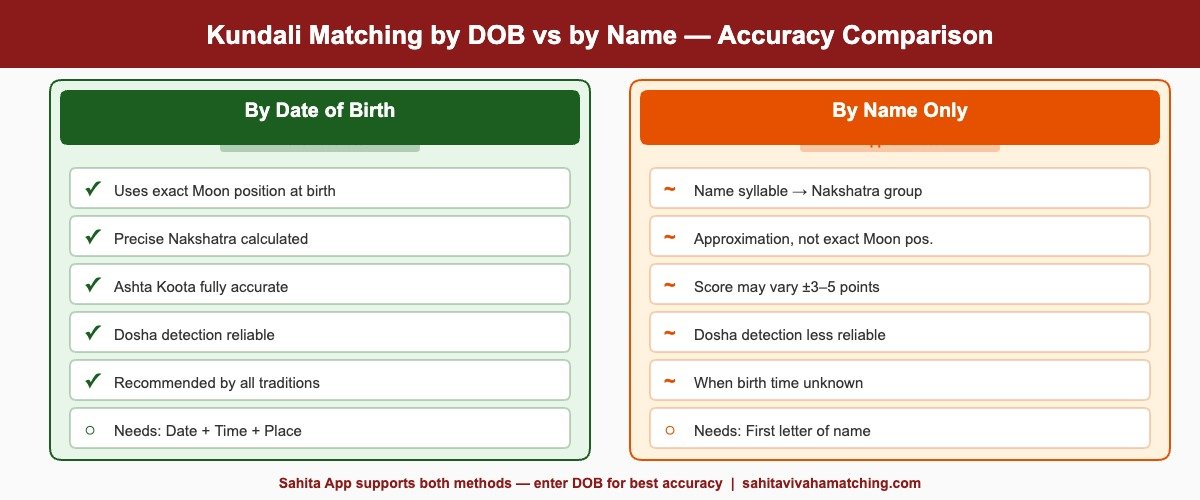
DOB-Based Matching vs Name-Based Matching — Accuracy Comparison
| Factor | DOB-Based | Name-Based |
|---|---|---|
| Nakshatra accuracy | Very high (with birth time) | Depends on traditional naming |
| Lagna calculation | Available (with birth time) | Not available |
| Mangala Dosha check | Available | Not available |
| Navamsha analysis | Available | Not available |
| Suitable for modern names | Yes | Only if named by Namakarana tradition |
| Best use case | Complete horoscope matching | Fallback when birth time is unknown |
DOB-based matching is recommended whenever birth details are available. Name-based matching remains a useful fallback for older alliances or when a full horoscope is not yet available.
What Can You Calculate with Just Date of Birth?
With just the date of birth (no time or place):
Can calculate:
- Approximate Nakshatra (reliable if Moon does not change Nakshatras that day)
- Approximate Rashi (reliable if Moon does not change signs that day)
- Sun sign and approximate planetary positions
- Guna Milan score (if Nakshatra is clear)
- Nadi, Bhakut, and Gana Dosha (if Nakshatra is clear)
Cannot calculate reliably:
- Exact Nakshatra Pada
- Lagna (Ascendant) — changes every 2 hours
- Mangala Dosha — requires Lagna chart
- Navamsha positions
- Precise Dasha balance at birth
For a complete horoscope matching assessment including Mangala Dosha, birth time is needed.
Marriage Matching by Date of Birth — Common Questions
Is date of birth enough for kundali matching?
For the Guna Milan (Ashta Koota) score, date of birth alone is often sufficient — provided the Moon’s Nakshatra is clear for that date. However, for a complete match report including Mangala Dosha and Lagna analysis, birth time and place are also needed.
Can I match kundali using only date of birth without time?
Yes, the Sahita app supports date-only matching and will calculate the Guna Milan score based on the Moon’s position for that date. If the Nakshatra is ambiguous (Moon transitioning between two Nakshatras on that date), the app will indicate this and offer options.
What if I don’t know the place of birth?
Place of birth is used to apply geographic corrections. If you don’t know the exact place, entering the nearest major city for that region is generally close enough for most calculations, particularly for the Moon’s Nakshatra.
My date of birth is correct but I don’t know the time — should I not do kundali matching?
You can and should still proceed with date-based matching. Just be aware that Mangala Dosha analysis will be limited. The Guna Milan score is usually reliable from the date alone.
How Sahita App Handles Date-of-Birth Matching
The Sahita app’s kundali matching by date of birth is straightforward:
- Enter the date of birth for bride and groom (time and place optional but recommended)
- The app calculates the Moon’s position from the date (or date + time + place)
- Nakshatra and Rashi are derived
- Full 8-koota Guna Milan analysis runs automatically
- Nadi Dosha and Bhakut Dosha are flagged if present
- If birth time is provided, Mangala Dosha check is also run
- Complete report is generated — shareable via WhatsApp, downloadable as PDF
Free to use on Android. No signup required for the basic report.
Summary
Kundali matching by date of birth is the most accurate and complete method of Vedic marriage compatibility assessment. With just the date of birth, you can usually get a reliable Guna Milan score. With date + time + place, you get the full picture including Mangala Dosha and Lagna analysis. The Sahita app supports all input combinations and delivers a complete free report on Android.
Also read: Kundali Matching by Name | What is Ashta Koota Matching? | Horoscope Matching for Marriage