Can you do kundali milan by name only? The answer is yes — kundali milan by name is a well-established method in Vedic astrology with a strong classical basis. It is particularly useful when the exact birth time of one or both partners is unknown. Kundali milan by name uses the first syllable of the name to determine the Nakshatra and run the full Ashta Koota compatibility analysis.
FREE TOOL · NO LOGIN · WORKS OFFLINE
Match kundali by name — the honest way. We show the nakshatra each name maps to before scoring, and ask you when the spelling is ambiguous.
Match by name now →This guide explains how kundali milan by name works, how it differs from DOB-based matching, and what its accuracy limitations are — whether you are matching by name only or by name and date of birth combined.
What is Kundali Matching by Name?
In the Vedic naming tradition, every child is traditionally given a name whose first syllable corresponds to the Nakshatra (birth star) of the child. This is called the Namakarana ceremony — the naming ritual performed on the 11th or 12th day after birth, where the family pandit determines the baby’s Nakshatra from the birth chart and assigns a name starting with the corresponding syllable.
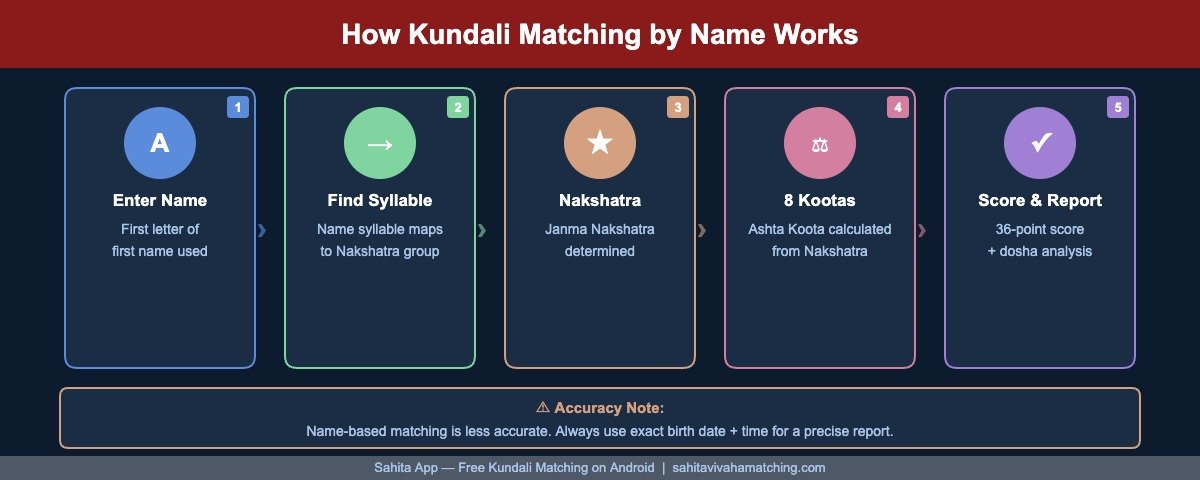
When kundali matching is done by name, the process works in reverse: the first syllable of the name is used to identify the Nakshatra, and then the Nakshatra is used to run the full Ashta Koota (8-koota) analysis. The result is a Guna Milan score out of 36, identical in format to DOB-based matching — just derived from a different starting point.
How Is Nakshatra Derived from Name?
In Vedic astrology, the 27 Nakshatras are each associated with specific syllables called Aksharas (sound groups). Each Nakshatra has four Padas (quarters), and each Pada has an assigned syllable. When a child is named after their Nakshatra, the first syllable of the name points to both the Nakshatra and the specific Pada.
Here are a few examples to illustrate:
| Starting Syllable | Nakshatra | Pada |
|---|---|---|
| Chu, Che | Ashwini | 1st, 2nd |
| La, Li | Rohini | 1st, 2nd |
| Ka, Ki | Pushya | 1st, 2nd |
| Ma, Mi | Magha | 1st, 2nd |
| Pa, Pi | Uttara Phalguni | 1st, 2nd |
| Ra, Ri | Hasta | 1st, 2nd |
| Na, Ni | Jyeshtha | 1st, 2nd |
| Ye, Yo | Moola | 1st, 2nd |
| Bu, Bhu | Uttara Ashadha | 1st, 2nd |
| Ga, Gi | Revati | 1st, 2nd |
The full table covers all 27 Nakshatras x 4 Padas = 108 syllable-Nakshatra-Pada combinations. A complete syllable mapping table is embedded in the Sahita app for reference.
Kundali Matching by Name Only vs by Name and Date of Birth
There are two variations of name-based matching:
Name Only (no birth date available):
Only the first syllable of each partner’s name is used. The Nakshatra is derived from the syllable, and Ashta Koota matching is run. This is the fallback method when no birth details are available — such as in older records, or where rural families did not document exact birth times.
Accuracy limitation: Without a birth date and time, the exact Pada (quarter) may be uncertain. If the name starts with a syllable shared between two Padas of different Nakshatras, there may be ambiguity. In practice, most syllable-Nakshatra mappings are unique enough that this is not a problem for common names.
Name + Date of Birth:
The most accurate form of name-based matching. The date of birth allows independent calculation of the Nakshatra from the Moon’s position. The name is used as a secondary cross-check — confirming that the given name aligns with the calculated Nakshatra. If they match, confidence in the Nakshatra is very high. If they do not match (possible if the naming was not done per traditional Namakarana), the DOB-derived Nakshatra takes precedence.
How Accurate Is Name-Based Kundali Matching?
Name-based matching is reasonably accurate when the name was assigned through the traditional Namakarana ceremony — which ensures the name’s first syllable corresponds to the birth Nakshatra. In this case, name-based matching produces the same Guna Milan result as DOB-based matching for the same person.
However, accuracy can be reduced in these situations:
1. Modern naming without Namakarana: Many urban families today choose names based on preference, meaning, or family tradition — without following the syllable-Nakshatra link. In these cases, the name does not reliably point to the correct Nakshatra.
2. Shortened or Anglicised names: If the name used for matching is a shortened form (e.g., “Sam” instead of “Sameer,” “Priya” instead of “Priyanka”), the first syllable may differ from the original Vedic name used in the Namakarana.
3. Regional transliteration variations: The same name can be spelled differently across regional languages and scripts. Transliteration differences can occasionally affect syllable mapping.
For the highest accuracy in kundali matching, DOB-based matching using exact birth time and place is always recommended when the information is available. Name-based matching is best used as a fallback or as a cross-check.
Name-Based Matching vs Other Compatibility Methods
Name-based kundali matching is sometimes confused with numerology-based compatibility, which is an entirely different system. Here is the distinction:
| Method | Based On | System | Used In |
|---|---|---|---|
| Vedic name matching | First syllable to Nakshatra | Ashta Koota (Vedic) | Traditional Hindu marriages |
| Numerology matching | Numerical value of full name | Western/Chaldean numerology | General compatibility |
| DOB matching | Moon position at birth | Ashta Koota (Vedic) | Traditional Hindu marriages |
Kundali matching by name, as practised in Vedic astrology, is based on the syllable-to-Nakshatra mapping — not on adding up the numbers in a name. These are fundamentally different approaches and should not be confused.
When Should You Use Name-Based Matching?
Name-based kundali matching is particularly useful in these situations:
1. Exact birth time is unknown: This is the primary use case. If a potential alliance comes from a family that does not have a detailed horoscope, starting with name-based matching gives you a working Guna Milan score while you seek more birth details.
2. Initial screening of multiple alliances: When a family is reviewing several potential alliances at once, name-based matching provides a quick first filter to identify strong and weak matches before investing in detailed kundali preparation.
3. Cross-checking existing horoscope data: If you already have a calculated Nakshatra from a horoscope, the first syllable of the name should align with that Nakshatra. Name-based cross-checking helps verify the accuracy of the horoscope.
4. Older family records: In older generations, detailed birth time records were not always maintained. Family elders may know a person’s name and approximate birth year — name-based matching allows compatibility to be assessed even with minimal data.
Kundali Milan by Name — Step by Step
Here is the step-by-step process for kundali milan by name:
- Identify the first syllable of the bride’s traditional/given name.
- Map it to the corresponding Nakshatra using the syllable-Nakshatra table.
- Identify the Pada (quarter) if the syllable mapping is specific enough.
- Derive the Rashi (Moon sign) from the Nakshatra — each Nakshatra spans part of one or sometimes two signs.
- Repeat steps 1–4 for the groom’s name.
- Run the Ashta Koota analysis — all 8 kootas — comparing the two Nakshatras.
- Review the score out of 36 and check for Doshas (Nadi, Bhakut, Gana).
The Sahita app automates all of this. You simply enter the name, and it maps the syllable to the Nakshatra and runs the full Guna Milan calculation. The result is a complete Ashta Koota report with individual koota scores and Dosha flags.
How Sahita App Does Kundali Milan by Name
The Sahita app makes kundali milan by name simple with multiple input modes:
- Name only: Enter first name; the app maps the leading syllable to Nakshatra automatically
- Name + DOB: Enter name and date/time/place of birth; DOB-derived Nakshatra is used with the name as a cross-check
- Manual Nakshatra selection: If you already know the Nakshatra from a horoscope, you can enter it directly
All modes produce the same full 36 Guna Milan report with Ashta Koota breakdown, Nadi Dosha flag, and Mangala Dosha check. The report is available free and can be shared via WhatsApp.
Summary
Kundali milan by name is a legitimate Vedic method based on the syllable-to-Nakshatra mapping system rooted in the Namakarana tradition. It works most reliably when the name was assigned through traditional Vedic naming. When the birth time is known, DOB-based matching is always more accurate. The Sahita app supports both methods — name-only, name + DOB, and manual Nakshatra entry — giving you flexibility regardless of what birth details are available.
Download Sahita free on Android to check kundali matching by name in seconds.
Also read: Kundali Matching by Date of Birth | What is Ashta Koota Matching? | 36 Guna Milan Score Guide