Horoscope matching for marriage — known as Kundali Milan or Jataka Porutham depending on the region — is a central practice in Hindu wedding traditions. Across North and South India and the Indian diaspora worldwide, checking horoscope compatibility before a marriage alliance is considered essential. But what exactly does horoscope matching for marriage check, and how accurate is it?
FREE TOOL · NO LOGIN · WORKS OFFLINE
Match your kundalis free — right now. Full 36 Guna Ashta Koota with all 8 kootas and Manglik for both partners, computed in your browser. Nothing uploaded.
Run the free kundali match →This guide covers the complete Vedic framework for horoscope matching for marriage — what factors are assessed, how the process works, what the results mean, and how to get a free report with the Sahita app.
What is Horoscope Matching for Marriage?
Horoscope matching for marriage is the process of comparing two birth charts (kundalis or jatakas) to assess whether two people are compatible for a long, harmonious marriage. A birth chart is a map of the sky at the exact moment and location of a person’s birth — it records the positions of the Sun, Moon, and all planets across the 12 houses.
In the Vedic tradition, marriage compatibility is not assessed by comparing personality types or interests. Instead, it is assessed by looking at the cosmic blueprint of each individual and determining whether the two blueprints complement or conflict with each other across key areas of life.
What Does Horoscope Matching Check?
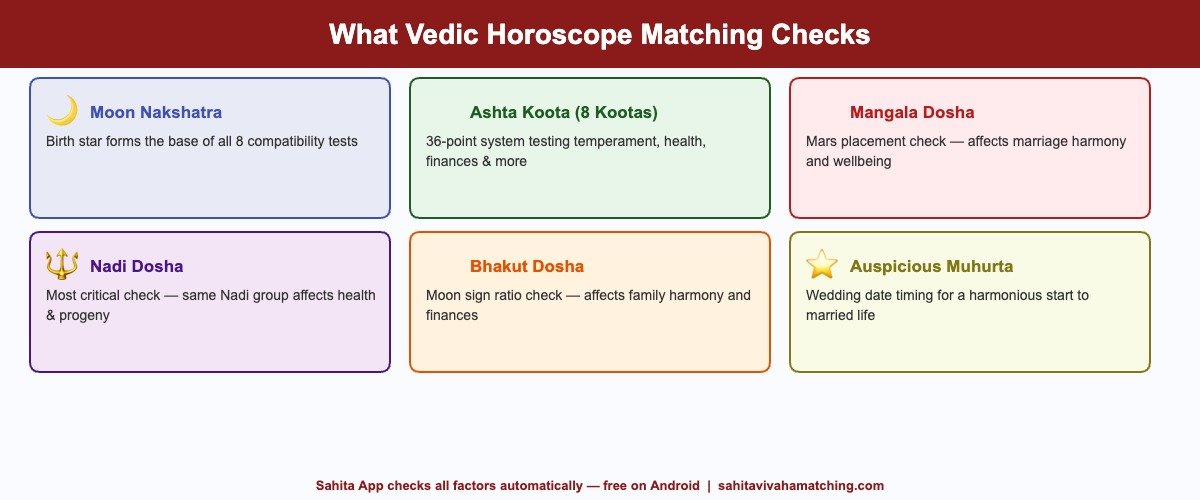
A complete Vedic horoscope matching for marriage examines several layers:
1. Ashta Koota (8-Koota Guna Milan)
This is the most commonly used system, and what most people mean when they talk about “horoscope matching.” It compares the Moon’s Nakshatra in both charts across 8 parameters and produces a score out of 36. A score of 18+ is the minimum threshold; 25+ is considered good. (See: What is Ashta Koota Matching?)
2. Mangala Dosha
Mars’s placement in specific houses (1, 2, 4, 7, 8, 12) is checked in both charts. If only one partner has Mangala Dosha, it is traditionally flagged as a concern. If both have it, the Dosha is generally considered cancelled.
3. Nadi Dosha
Part of the Ashta Koota system but important enough to check separately. If both partners share the same Nadi (birth star energy group), Nadi Dosha is present and scores 0 on the highest-weighted koota. Exceptions apply in specific cases.
4. Navamsha Chart Compatibility
The Navamsha (D9) chart is a divisional chart that specifically represents marriage and partnership. Experienced Jyotishis examine whether the Navamsha charts of both partners are mutually supportive — particularly the placement of Venus, the 7th lord, and the 7th house.
5. 7th House Analysis
The 7th house in any birth chart is the house of marriage and partnership. Its lord, the planets placed in it, and the aspects it receives reveal a great deal about a person’s marriage destiny — the timing of marriage, the nature of the spouse, and potential challenges.
6. Dasha Compatibility
The planetary period (Dasha) that both partners are running during and after the wedding year is examined. A wedding during a challenging Dasha for either partner — particularly a Dasha involving 6th, 8th, or 12th house lords — may require extra scrutiny.
Horoscope Matching vs Kundali Matching — Same Thing?
These terms are used interchangeably and refer to the same practice. Regional naming differences:
| Term | Region | Language |
|---|---|---|
| Kundali Matching / Kundli Milan | North India | Hindi |
| Jataka Matching / Jathaka Porutham | South India | Kannada, Tamil, Telugu |
| Horoscope Matching | Pan-India | English |
| Patrika Milaan | Rajasthan, Gujarat | Hindi/Gujarati |
All of these refer to the same core Vedic practice of comparing birth charts before marriage. The underlying methodology — particularly Ashta Koota Milan — is consistent across most traditions.
How to Do Horoscope Matching Online
Doing horoscope matching online is simple with the right tool. Here is what you need:
Required information for each partner:
- Full name
- Date of birth
- Time of birth (as accurate as possible — within 15 minutes is ideal)
- Place of birth
What the tool calculates:
- Nakshatra (birth star) from Moon’s position at birth
- Rashi (Moon sign)
- Lagna (Ascendant / rising sign)
- All 8 koota scores (Ashta Koota Milan)
- Total Guna score out of 36
- Nadi Dosha flag (with exceptions check)
- Mangala Dosha flag (with cancellation check)
The Sahita app performs all of this automatically. Enter both sets of birth details and receive a complete horoscope compatibility report within seconds — free, on Android.
Understanding Your Horoscope Match Report
When you receive a horoscope matching report, here is how to read it:
Total Guna Score: The headline number. 18–36 means the alliance passes the basic compatibility threshold. Within this range, 18–24 is acceptable, 25–32 is good, and 33–36 is excellent.
Individual Koota Scores: The eight sub-scores that make up the total. Each tells you about a specific dimension of compatibility — from temperament (Gana) to physical harmony (Yoni) to mental connection (Graha Maitri).
Dosha Flags: Red or yellow flags indicating Nadi Dosha, Bhakut Dosha, or Gana Dosha within the Guna Milan system, plus Mangala Dosha from the planetary analysis. Always check whether exceptions or cancellations apply before treating a Dosha as final.
Compatibility Summary: An overall interpretation of the report — whether the match is recommended, acceptable, or needs further consultation.
How Accurate is Vedic Horoscope Matching?
This is a question that deserves a thoughtful answer. Vedic horoscope matching has been practiced for thousands of years and is deeply embedded in Indian cultural and spiritual life. Its accuracy from a traditional standpoint is well-established — the system was developed by Vedic sages as a practical tool for assessing long-term life compatibility across multiple dimensions.
From a modern perspective, its value lies in several things:
Structured framework: Rather than vague impressions, it gives families a systematic way to discuss compatibility across defined parameters — temperament, health, children, finances, emotional bond.
Cultural alignment: For families where the tradition is deeply held, a good kundali match provides genuine psychological confidence. The belief in the system itself is part of its value.
Dosha awareness: Identifying factors like Nadi Dosha or Mangala Dosha prompts families to seek remedies, consult more deeply, and approach the alliance with appropriate care — rather than rushing in blindly.
Where horoscope matching should not be used as the only decision factor: a good Guna score is not a guarantee of a happy marriage, and a moderate score is not a guarantee of failure. It is one important input among many — alongside the couple’s personalities, values, communication, and family compatibility.
Free Horoscope Matching Online — What to Look For
When choosing an online tool for horoscope matching, look for these features:
Accurate Nakshatra calculation: The tool should calculate the Nakshatra from the Moon’s exact position based on date, time, and place of birth — not just from the date alone.
All 8 koota scores shown individually: A tool that only shows the total Guna score is hiding important information. Each koota score matters.
Dosha detection with context: The tool should not just flag Doshas — it should also check and display applicable exceptions and cancellations.
No fabricated data: The report should be based purely on your birth details. Be wary of tools that claim very high scores regardless of input.
Shareable report: You should be able to share the report with family members or a pandit for review.
The Sahita app meets all of these criteria. It is free to download on Android and provides a complete horoscope matching report with full koota breakdown, Dosha detection, exception checking, and WhatsApp sharing.
Frequently Asked Questions
Is horoscope matching necessary for marriage?
In traditional Hindu families, yes — it is a customary practice considered important before proceeding with a marriage alliance. In more liberal families, it may be one factor among several. Whether it is treated as binding or advisory depends entirely on the family’s tradition and belief.
What if the Guna score is below 18?
A score below 18 traditionally indicates significant incompatibility. However, many families — particularly when other factors are strongly positive — consult a Jyotishi for a full chart reading rather than relying solely on the Guna score. A qualified astrologer can assess whether the total chart picture supports the alliance despite a lower Guna score.
Can horoscope matching be done after marriage?
Yes. Couples who married without kundali matching sometimes request a retrospective analysis, particularly if they are experiencing difficulties. Post-marriage analysis focuses less on compatibility scoring and more on identifying planetary periods affecting the marriage and appropriate remedies.
What is the best app for free horoscope matching online?
The Sahita app is rated 4.5 on Google Play and has been downloaded by over 10,000 families. It provides complete Ashta Koota analysis, Dosha detection, and a shareable report — all for free on Android.
Summary
Horoscope matching for marriage is a multi-layered Vedic compatibility assessment covering the Ashta Koota Guna Milan system, Mangala Dosha, Nadi Dosha, Navamsha analysis, and more. It provides a structured framework for families to evaluate horoscope matching for marriage compatibility before a formal commitment. The Sahita app brings the full power of this ancient system to your smartphone — free, accurate, and shareable.
Also read: What is Ashta Koota Matching? | 36 Guna Milan Score Guide | Janmakshar and Jataka Matching
Related: Can Manglik Marry Non-Manglik? Complete Mangal Dosha Guide (2026)