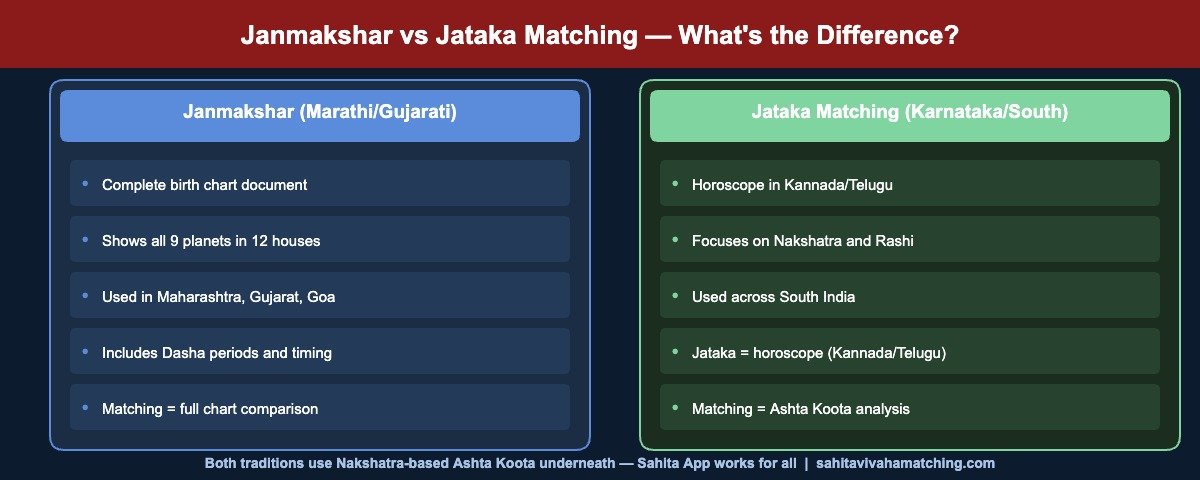
If you are looking to do janmakshar matching online, this guide explains everything you need to know. The terms janmakshar and jataka refer to the same concept in Vedic astrology: the birth horoscope — the astrological map of the sky at the moment of birth. Janmakshar is primarily used in Marathi and Gujarati communities, while jataka is the term in Kannada, Telugu, and Tamil traditions.
FREE TOOL · NO LOGIN · WORKS OFFLINE
Match your kundalis free — right now. Full 36 Guna Ashta Koota with all 8 kootas and Manglik for both partners, computed in your browser. Nothing uploaded.
Run the free kundali match →Janmakshar matching online and jataka matching for marriage both refer to comparing two birth horoscopes for marriage compatibility using the Vedic Ashta Koota system. This guide explains how it works and how to do it for free.
What is a Janmakshar / Jataka?
A janmakshar or jataka is a document that records the astrological positions at the time of birth. A traditional Indian horoscope typically includes:
Lagna (Ascendant): The zodiac sign rising on the eastern horizon at birth. It defines the first house of the chart and is considered the most personal point.
Rashi (Moon sign): The zodiac sign occupied by the Moon at birth. This is the basis for most Vedic compatibility calculations.
Nakshatra (Birth Star): The specific lunar mansion (one of 27) where the Moon was placed at birth. This is the starting point for the Ashta Koota Guna Milan system.
Planetary positions: The positions of all 9 Grahas — Sun, Moon, Mars, Mercury, Jupiter, Venus, Saturn, Rahu, and Ketu — in the 12 houses.
Dasha balance: The planetary period (Mahadasha) running at the time of birth, and the sequence of Dashas that will follow.
For marriage matching purposes, the most important elements are the Nakshatra, Rashi, and the Lagna chart (for Mangala Dosha analysis).
Jataka Matching for Marriage — How It Works
Jataka matching for marriage in the Vedic tradition follows the same core process regardless of regional terminology:
Step 1: Prepare both jaatakas
The bride’s and groom’s complete birth horoscopes are prepared — either by a Jyotishi or using a digital tool. The key data needed is name, date of birth, time of birth, and place of birth.
Step 2: Run Ashta Koota Guna Milan
The Nakshatras of both partners are compared across 8 kootas: Varna, Vashya, Tara, Yoni, Graha Maitri, Gana, Bhakut, and Nadi. Each koota is scored, and the total is expressed as a Guna score out of 36.
Step 3: Check for Doshas
Nadi Dosha, Bhakut Dosha, and Gana Dosha are checked within the Guna Milan system. Additionally, Mangala Dosha is assessed from each jataka individually by checking Mars’s house placement.
Step 4: Review exceptions and cancellations
Any Doshas found are checked against the classical exception conditions. Nadi Dosha may be cancelled if both partners have different Rashis. Mangala Dosha is cancelled if both partners have it. Detailed exceptions exist for each Dosha type.
Step 5: Overall assessment
The final picture is evaluated — Guna score + Dosha status + exception outcomes — to determine whether the match is auspicious, acceptable with caution, or inadvisable.
Janmakshar Matching vs Guna Milan — What’s the Difference?
These terms describe different levels of the same process:
Janmakshar matching (or jataka matching) refers to the complete practice of comparing two horoscopes for marriage — including Guna Milan, Dosha analysis, Navamsha review, and Dasha compatibility.
Guna Milan is specifically the Ashta Koota scoring component within the broader jataka matching process.
In everyday usage, many families say “janmakshar matching” or “jataka matching” when they mean specifically the Guna Milan score. But technically, a full jataka matching includes more than just the Guna score.
Regional Variations in Jataka Matching
While the Ashta Koota system is standard across most of North and South India, there are meaningful regional variations in how jataka matching is conducted:
Karnataka (Jataka Porutham):
Uses the standard 8-koota Ashta Koota system as the primary matching framework. Mangala Dosha (Kuja Dosha) is taken very seriously. The Navamsha (D9) chart is commonly reviewed for marriage-specific analysis. Community traditions vary between Brahmin, Lingayat, and Vokkaliga families.
Maharashtra (Janmakshar Milaan):
Similar to the standard Ashta Koota system. Rajju Dosha (an additional check for the 7th house) is sometimes included. Marathi Brahmins often follow specific Dharmasindhu guidelines for muhurta and compatibility.
Andhra Pradesh and Telangana (Jathakam):
Uses the Dashakoota (10-koota) system, which adds Rajju and Vedha checks to the standard 8 kootas. The maximum score in the Dashakoota system is not 36 — it uses a different total and interpretation scale. Rajju specifically checks for potential widowhood and is considered very important.
Tamil Nadu (Jathagam Porutham):
The 10 Porutham system is used — similar in spirit to Dashakoota but with slightly different parameters: Dina, Ganam, Yoni, Rasi, Rasyadhipati, Vasya, Rajju, Vedha, Mahendra, and Stree Deergham. Not all 10 Poruthams carry equal weight; Rajju and Dina are typically considered most critical.
Gujarat (Janmakshar):
Closely follows the standard Ashta Koota system. In some communities, the Manglik assessment is particularly emphasised, and a Shanti puja is commonly recommended even for partial Mangala Dosha.
Regional Summary Table
| Region | Term Used | System | Key Feature |
|---|---|---|---|
| Karnataka | Jataka / Jataka Porutham | 8-koota Ashta Koota | Kuja Dosha taken very seriously |
| Maharashtra | Janmakshar | 8-koota + Rajju sometimes | Dharmasindhu guidelines |
| Andhra / Telangana | Jathakam | 10-koota Dashakoota | Rajju and Vedha added |
| Tamil Nadu | Jathagam | 10 Porutham | Rajju and Dina most critical |
| North India | Kundali / Janam Patrika | 8-koota Ashta Koota | Standard Guna Milan |
How to Do Janmakshar Matching Online for Free
Doing jataka matching online is straightforward with a reliable tool. You will need name, date of birth, time of birth, and place of birth for both partners.
The Sahita app performs jataka matching online for free on Android:
- Enter birth details for bride and groom
- App calculates Nakshatra, Rashi, and Lagna for both
- Runs full 8-koota Guna Milan analysis
- Flags Nadi Dosha and Mangala Dosha with exception checks
- Generates a complete janmakshar compatibility report
- Report can be shared via WhatsApp or downloaded as a premium PDF
For South Indian families using the Dashakoota (10-koota) or Porutham (10-match) systems, Sahita also supports extended analysis options.
What to Check Beyond the Guna Score
A complete jataka matching for marriage goes beyond the Guna score. Here are the additional checks experienced Jyotishis typically perform:
Navamsha chart (D9): The divisional chart specifically for marriage. The 7th house in the Navamsha and the placement of Venus and the 7th lord reveals deeper marriage compatibility signals.
7th house and lord: The condition of the 7th house in the main chart (Lagna chart) — whether it is afflicted by malefics or supported by benefics — provides insight into marriage prospects.
Marriage timing (Dasha-Antardasha): The planetary period sequence indicates when marriage is likely and whether the Dasha running during the marriage period is favourable.
Saturn and Rahu analysis: Long-term malefic placements in or aspecting the 7th house can create challenges in marriage that are worth knowing about in advance.
Summary
Janmakshar matching online and jataka matching for marriage are regional terms for the same essential Vedic practice — comparing two birth horoscopes to assess marriage compatibility. The core method is the Ashta Koota Guna Milan system, producing a score out of 36. Regional variations exist (Karnataka, Maharashtra, Andhra, Tamil Nadu each have their specific traditions), but the underlying logic is consistent. A complete jataka matching includes the Guna score, Dosha analysis, and additional chart-level checks.
The Sahita app makes janmakshar matching online simple, free, and comprehensive. Download on Android.
Also read: What is Ashta Koota Matching? | Horoscope Matching for Marriage — Complete Guide | Kundali Matching by Date of Birth
Related: Telugu Jathakam Porutham for Marriage: Complete Compatibility Guide (2026)
Related: Can Manglik Marry Non-Manglik? Complete Mangal Dosha Guide (2026)