जब दो परिवार विवाह बंधन का मूल्यांकन करने के लिए बैठते हैं, तो पारंपरिक हिंदू प्रथा में पहला कदम जन्म कुंडली की तुलना करना है। इस प्रक्रिया के मूल में है अष्ट कूट मिलान - एक प्राचीन वैदिक ज्योतिष वह प्रणाली जो आठ विशिष्ट मापदंडों के आधार पर विवाह अनुकूलता का आकलन करती है। अष्ट शब्द का अर्थ है आठ, और कूट का अर्थ है अनुकूलता बिंदु - अधिकतम 36 गुणों के साथ एक संरचित स्कोरिंग प्रणाली बनाना।
यह मार्गदर्शिका सभी आठ कूटों के बारे में बताती है, अष्ट कूट मिलान स्कोर कैसे काम करता है, आपके विवाह गठबंधन के लिए इसका क्या अर्थ है, और साहिता ऐप दोनों भागीदारों के जन्म विवरण से इसकी सटीक गणना कैसे करता है।
परिचय
जब दो परिवार विवाह गठबंधन पर चर्चा करने के लिए एक साथ आते हैं, तो पहली बात जो पारंपरिक हिंदू परिवार आमतौर पर करता है वह कुंडली की तुलना करता है। इस प्रक्रिया के मूल में है अष्ट कूट मिलान - एक प्राचीन वैदिक प्रणाली जो आठ अलग-अलग मापदंडों पर विवाह अनुकूलता का मूल्यांकन करती है।
"अष्ट" शब्द का अर्थ है आठ, और "कूट" का अर्थ है समूह या बिंदु। साथ में, अष्ट कूट मिलान एक संरचित स्कोरिंग प्रणाली है जो दो जन्म कुंडली के बीच अनुकूलता के आठ क्षेत्रों को अंक प्रदान करती है। अधिकतम संभव स्कोर है 36 गुण, और सिस्टम को यह आकलन करने के लिए डिज़ाइन किया गया है कि क्या दो व्यक्ति लंबे, सामंजस्यपूर्ण विवाह के लिए उपयुक्त हैं।
यह मार्गदर्शिका सभी आठ कूटों के बारे में बताती है, स्कोरिंग कैसे काम करती है, आपके गुना स्कोर का क्या मतलब है, और साहिता ऐप जैसे टूल दोनों भागीदारों के जन्म विवरण का उपयोग करके इसकी सटीक गणना कैसे करते हैं।
अष्ट कूट प्रणाली क्या है?
अष्ट कूट मिलान किस पर आधारित है? नक्षत्र (जन्म नक्षत्र) वर-वधू दोनों का। जन्म के समय चंद्रमा की स्थिति से नक्षत्र का निर्धारण होता है। यही कारण है कि कभी-कभी विवाह के लिए कुंडली मिलान भी कहा जाता है नक्षत्र पोरुथम दक्षिण भारत में या Nakshatramilan अन्य परंपराओं में.
आठ कूटों में से प्रत्येक अनुकूलता के एक विशिष्ट आयाम का परीक्षण करता है - मूल स्वभाव से लेकर यौन सद्भाव, वित्तीय स्थिरता और बच्चों के स्वास्थ्य तक। यह प्रणाली शास्त्रीय ग्रंथों से आती है जिनमें शामिल हैं Brihat Parashara Hora Shastra और Muhurta Chintamani और सदियों से वैदिक ज्योतिषियों द्वारा इसका उपयोग किया जाता रहा है।
8 कूट - पूर्ण विराम
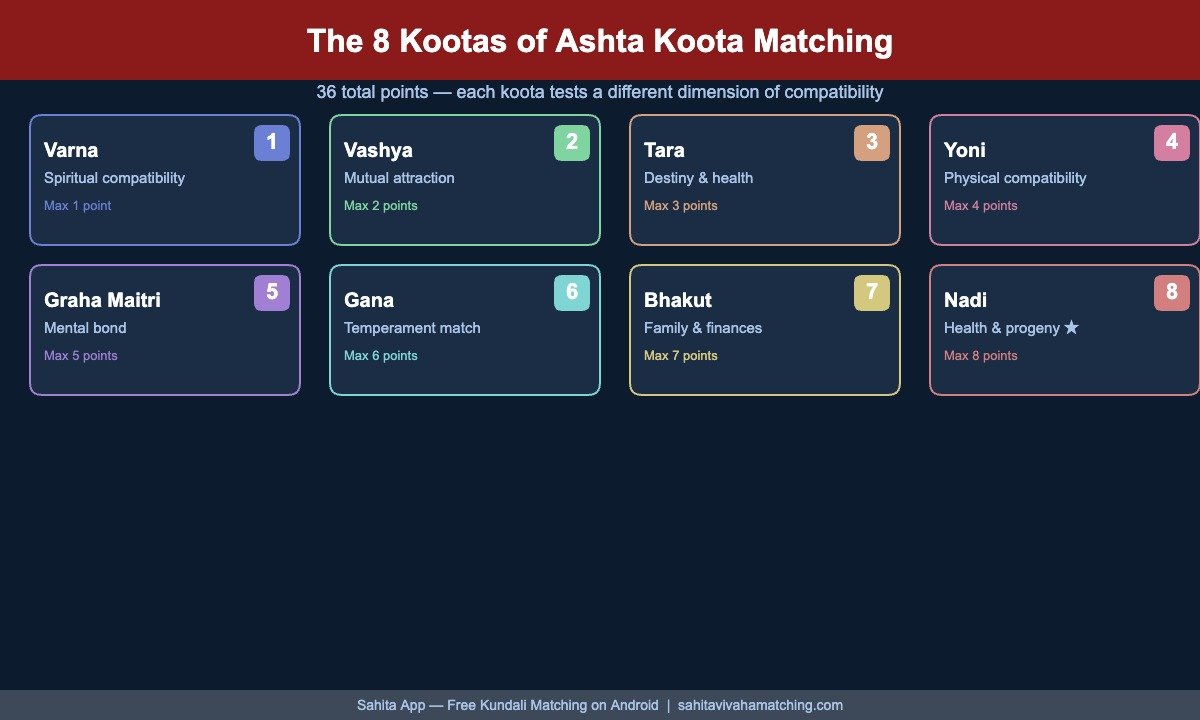
नीचे दी गई तालिका प्रत्येक कूटा, उसके अधिकतम अंक और वह क्या मापती है, दर्शाती है।
| # | नाम संकलित करें | अधिकतम अंक | यह क्या मापता है |
|---|---|---|---|
| 1 | वार्ना | 1 | आध्यात्मिक अनुकूलता और अहंकार का स्तर |
| 2 | Vashya | 2 | पारस्परिक नियंत्रण, आकर्षण और प्रभुत्व |
| 3 | तारा | 3 | भाग्य अनुकूलता और दीर्घकालिक स्वास्थ्य/भाग्य |
| 4 | योनि | 4 | शारीरिक और यौन अनुकूलता |
| 5 | ग्रह मैत्री | 5 | चंद्र राशियों के बीच मानसिक अनुकूलता और मित्रता |
| 6 | गण | 6 | Temperament and nature (Deva, Manushya, or Rakshasa) |
| 7 | Bhakut | 7 | भावनात्मक अनुकूलता और पारिवारिक कल्याण |
| 8 | नाड़ी | 8 | स्वास्थ्य अनुकूलता और संतान (संतानोत्पत्ति) |
| कुल | 36 |
प्रत्येक कूटा का विस्तृत विवरण
1. चेतावनी (1 अंक)
वर्ण किसी व्यक्ति के नक्षत्र के आधार पर उसकी आध्यात्मिक या मनोवैज्ञानिक प्रकृति का प्रतिनिधित्व करता है। चार वर्ण प्रकार हैं - ब्राह्मण, क्षत्रिय, वैश्य और शूद्र - जो इस संदर्भ में जाति श्रेणियों के बजाय आध्यात्मिक विकास के स्तर का प्रतिनिधित्व करते हैं। अष्ट कूट मिलान में, पूर्ण अंकों के लिए दूल्हे का वर्ण आदर्श रूप से दुल्हन के वर्ण के बराबर या उससे अधिक होना चाहिए। समान वर्ना को 1 अंक मिलता है; एक बेमेल स्कोर 0.
2. वश्य (2 अंक)
वश्या दो साझेदारों के बीच प्राकृतिक आत्मीयता और पारस्परिक प्रभाव का परीक्षण करता है। 12 राशियों को पांच श्रेणियों में बांटा गया है: मानव (मानव), चतुष्पद (चतुष्पाद), जलचर (जलचर), वनचर (जंगली), और कीट (कीड़े)। पूर्ण अंक (2) तब प्राप्त होते हैं जब संकेतों पर मजबूत पारस्परिक नियंत्रण होता है; आंशिक बिंदु (1) जब एकतरफा प्रभाव हो; 0 जब कोई कनेक्शन न हो.
3. तारा (3 अंक)
तारा (या दीना) कूटा दीर्घकालिक भाग्य और स्वास्थ्य के संदर्भ में दूल्हा और दुल्हन के नक्षत्रों के बीच संबंधों की जांच करता है। दूल्हे के नक्षत्र को दुल्हन के नक्षत्र से गिना जाता है, और परिणाम (9 से विभाजित) तारा स्कोर निर्धारित करता है। विषम शेषफल शुभ माने जाते हैं; यहां तक कि अशुभ भी. यह कूटा विशेष रूप से शादी के बाद दोनों भागीदारों की लंबी उम्र और स्वास्थ्य से जुड़ा हुआ है।
4. योनि (4 अंक)
योनी कूटा शारीरिक और यौन अनुकूलता का आकलन करता है। प्रत्येक नक्षत्र को एक प्रतीकात्मक जानवर सौंपा गया है - जैसे कि घोड़ा, हाथी, भेड़, या साँप - और अनुकूलता इस बात से निर्धारित होती है कि ये जानवर प्रकृति में एक-दूसरे से कैसे संबंधित हैं। मित्रवत जानवर 4 अंक अर्जित करते हैं; तटस्थ जोड़ियों का स्कोर 2-3; शत्रुतापूर्ण जोड़ियों का स्कोर 0-1। खराब योनि स्कोर भागीदारों के बीच मौलिक शारीरिक असंगति का संकेत दे सकता है।
5. ग्रह मैत्री (5 अंक)
This koota measures the compatibility of the ruling planets (lords) of the Moon signs (Rashis) of both partners. If the two planetary lords are natural friends, the couple is likely to have a harmonious mental connection and mutual understanding. Friendly lord pairs score 5 points; neutral pairs score 3–4; enemy pairs score 0–1. Graha Maitri is considered one of the most important kootas for a successful long-term marriage.
6. Gana (6 points)
Gana koota classifies each Nakshatra into one of three categories — Deva (divine/spiritual), Manushya (human), and Rakshasa (fierce/intense). Ideally, both partners should belong to the same Gana. Two Devas or two Manushyas together score 6 points. A Deva and Manushya match may score partial points. Deva and Rakshasa is generally considered an incompatible match and scores 0. This koota reflects fundamental differences in outlook, temperament, and lifestyle.
7. Bhakut (7 points)
Bhakut (also written Bhakoot) is one of the highest-weighted kootas, carrying 7 points. It tests the emotional and relational compatibility between the Moon signs of the couple. The calculation involves the relative position of the two Rashis. Certain combinations — like 6-8 (Shad-Ashtaka), 5-9, or 2-12 positions — are considered inauspicious and may indicate emotional distance, financial troubles, or conflict. A compatible Bhakut scores the full 7 points; an inauspicious one scores 0.
8. Nadi (8 points)
Nadi carries the maximum weight in the entire system — 8 points — making it the most important koota. Each Nakshatra belongs to one of three Nadis: Aadi (Vata), Madhya (Pitta), or Antya (Kapha). If both partners belong to the same Nadi, it is called नाड़ी दोष and scores 0 points. Different Nadis score the full 8 points. Nadi Dosha is traditionally considered a serious incompatibility, linked to health of offspring and marital harmony, though certain exceptions (Nadi Dosha Parihar) can nullify it.
What Does Your Total Guna Score Mean?
After adding up the points from all 8 kootas, you get a total score between 0 and 36. Here is how to interpret it:
| Score Range | Interpretation | Recommendation |
|---|---|---|
| 0 – 17 | Poor compatibility | Marriage generally not recommended without deeper analysis |
| 18 – 24 | Acceptable compatibility | Proceed with caution; check for Doshas |
| 25 – 32 | Good compatibility | Recommended; strong foundation for marriage |
| 33 – 36 | Excellent compatibility | Ideal match; very auspicious |
It is important to understand that the total score is not the only factor. Even a score above 18 may be reconsidered if there is an uncancelled Nadi Dosha, Bhakut Dosha, or Mangala Dosha present. Conversely, a score slightly below 18 may still be acceptable if all eight individual kootas are analysed carefully and no major Dosha is detected.
Important Doshas to Check Alongside Guna Score
Even when the Guna score is satisfactory, traditional Vedic astrologers check for these specific issues:
How Does Sahita App Calculate Ashta Koota Matching?
The Sahita app performs the full Ashta Koota analysis automatically using the birth details of both partners. Here is what you need to enter:
- Full name (used for display; Nakshatra is derived from date and time of birth)
- जन्मतिथि
- Time of birth (as accurate as possible)
- जन्म स्थान
From this information, Sahita calculates the नक्षत्र, Rashi (Moon sign), and Lagna (Ascendant) for both individuals. It then runs all 8 koota calculations using the classical tables from Vedic astrology and produces a final Guna score with a detailed breakdown of each koota — showing how many points were scored and why.
Sahita also automatically flags Nadi Dosha and Mangala Dosha if present, and explains whether any exceptions or cancellations apply. The report can be shared via WhatsApp or saved as a PDF.
Ashta Koota vs Other Matching Systems
While Ashta Koota is the most widely used system in North and South India, there are regional variations worth knowing:
सारांश
Ashta Koota matching is a structured, 8-point Vedic system that evaluates marriage compatibility across temperament, health, emotional bond, physical harmony, and more. A total score of 36 Gunas represents the maximum; 18 and above is the minimum generally recommended threshold for marriage. However, individual koota scores and the presence of Doshas must also be reviewed carefully — the total score alone does not tell the full story.
The Sahita app automates this entire process — from Nakshatra derivation to full koota scoring and Dosha detection — giving you an accurate, detailed kundali matching report in seconds. Free to download on Android.
यह भी पढ़ें: 36 Guna Milan — How Many Gunas Are Needed for Marriage? | नाड़ी दोष क्या है? | Guna Milan vs Mangala Dosha
Leave a Reply to ನಾಡಿ ದೋಷ ಎಂದರೇನು? ಪರಿಹಾರ ಏನು? | Nadi Dosha in Kannada – Sahita – ವಿವಾಹ ಹೊಂದಾಣಿಕೆ | Kannada Vivaha Matching App उत्तर रद्द