Category: Horoscope Matching

Horoscope, jataka, and janmakshar matching for marriage

  • Can Manglik Marry Non-Manglik? Complete Mangal Dosha Guide (2026)

    Can Manglik Marry Non-Manglik? Complete Mangal Dosha Guide (2026)

    Can Manglik Marry Non-Manglik — Mars Mangal Dosha Symbol in Vedic Astrology

    Can a Manglik Marry a Non-Manglik? The Truth About Mangal Dosha in 2026

    Few things create more anxiety during a marriage proposal than the word Manglik. When a family discovers one partner has Mangal Dosha, it triggers fear and confusion. The short answer is yes — can manglik marry non manglik is one of the most common questions in Vedic marriage matching, and in most cases it is entirely possible.

    The short answer: Yes, absolutely. Here’s the complete truth about Mangal Dosha in 2026.

    What Is Mangal Dosha?

    Mangal Dosha (also called Kuja Dosha) occurs when Mars (Mangal) is placed in the 1st, 2nd, 4th, 7th, 8th, or 12th house of a person’s birth chart. About 50% of all Indians have some form of Mangal Dosha — a statistic that alone tells us it cannot be as catastrophic as popular belief suggests.

    Types of Mangal Dosha

    Type Description Severity
    Poorna (Full) Mangal Dosha Mars in 7th or 8th house High — most serious
    Anshik (Partial) Mangal Dosha Mars in 1st, 2nd, 4th, or 12th house Moderate — often cancelled
    Cancelled Mangal Dosha Cancellation conditions apply Minimal — safe to proceed

    Can Manglik Marry Non-Manglik? Here Is the Truth

    Yes — and here is why it’s often perfectly fine:

    1. Partial Mangal Dosha Is Very Common

    Most people classified as “Manglik” have Anshik (partial) Mangal Dosha, which is diluted by other planetary placements. Partial Mangliks can typically marry non-Mangliks without major concerns.

    2. Natural Cancellation Factors

    Mangal Dosha is automatically cancelled in these situations:

    • Mars is in Aries, Scorpio, or Capricorn (own/exalted signs)
    • Both partners are Manglik — doshas cancel each other
    • Non-Manglik partner has strong Saturn or Jupiter protecting the 7th house
    • Mars is conjunct or aspected by Jupiter
    • The Manglik was born on a Tuesday
    • Mars is in the 1st house in Aries or Scorpio Ascendant

    3. Dosha Weakens After Age 28

    The intensity of Mangal Dosha reduces significantly after the age of 28. This is why late urban marriages (after 28) face far fewer concerns about this dosha.

    When Should You Worry About Can Manglik Marry Non-Manglik Compatibility?

    Full Mangal Dosha (Mars in 7th or 8th house) without any cancellation is considered the most serious. In this case, traditional astrologers strongly recommend either matching with another Manglik or performing Kumbh Vivah before the wedding.

    Proven Mangal Dosha Remedies for Can Manglik Marry Non Manglik Situations

    • Kumbh Vivah — symbolic marriage to a Peepal tree or Vishnu idol before the actual wedding
    • Mangal Shanti Puja — performed on Tuesdays at a Hanuman or Bhairav temple
    • Visit Hanuman temple every Tuesday and offer sindoor
    • Donate red lentils (masoor dal) on Tuesdays
    • Wear Red Coral (Moonga) gemstone in a gold ring on the ring finger of the right hand

    When Two Mangliks Marry Each Other

    Many people who ask can manglik marry non manglik do not realise that when both partners have Mangal Dosha, the doshas cancel each other out — creating a balanced, often intensely passionate relationship. However, other compatibility factors (guna milan, Nadi Dosha, Bhakoot) must still be checked. See our Nadi Dosha guide.

    Check Mangal Dosha Free with Sahita App

    The Sahita Vivaha Matching App automatically detects Mangal Dosha in both charts, shows the house placement of Mars, and checks for cancellation conditions — all as part of the free 36 Guna Milan report. Whether you are asking can manglik marry non manglik or checking for double Mangal Dosha, the app gives you a clear instant answer.

    Download Sahita free on Google Play

    Frequently Asked Questions

    Is Mangal Dosha really dangerous?

    Not inherently — 50% of people have it and lead happy married lives. Severity depends entirely on the house, sign, and cancellation factors present in the chart.

    Which is more serious — Mangal Dosha or Nadi Dosha?

    Nadi Dosha carries 8 out of 36 points (the highest in the Ashtakoota system) and is generally considered more critical in kundali matching. Read our detailed Nadi Dosha guide.

    Does Mangal Dosha affect the wife or husband more?

    Traditional texts say Mangal Dosha in a woman’s chart affects the husband’s longevity, while in a man’s chart it affects the marriage’s harmony. Modern astrologers take a more balanced view.

    For a deeper understanding of the full marriage compatibility picture, read our guide on Nadi Dosha — the other critical Vedic dosha that affects kundali matching. Both Mangal Dosha and Nadi Dosha should be checked before finalising any match. When families ask can manglik marry non manglik, the answer depends on a complete dosha analysis — not just one factor in isolation.

    Related Reading: Horoscope Matching for Marriage · Gun Milan Explained

  • Auspicious Marriage Dates 2026-2027: Best Hindu Muhurat for Wedding

    Auspicious Marriage Dates 2026-2027: Best Hindu Muhurat for Wedding

    Auspicious Marriage Dates 2026 and 2027 — Hindu Wedding Muhurat Calendar

    Auspicious Marriage Dates 2026-2027: Complete Hindu Wedding Muhurat Calendar

    Planning a Hindu wedding requires more than booking a venue — finding the right auspicious marriage dates 2026 and 2027 is essential. The right date, aligned with favorable tithis, nakshatras, and planetary positions, blesses the marriage with prosperity and longevity.

    Best Auspicious Marriage Dates 2026 — Month by Month

    MonthAuspicious DatesNotes
    January 202616, 17, 18, 20, 22, 27, 28Post-Makar Sankranti window
    February 20265, 6, 8, 10, 12, 14, 19, 20, 21, 24, 25, 26Peak month — 12 auspicious dates
    March 20263, 4, 5, 6, 8, 9, 15, 17Strong spring window
    April 202610, 13, 14, 20, 22, 24, 26After Navratri
    May 20261, 3, 5, 6, 7, 8, 13, 148 dates — peak pre-summer window
    June 202621, 22, 23, 24, 25, 26, 27, 29Good June window
    July – October 2026Very limitedChaturmas period — traditionally avoided
    November 202621, 25Post-Diwali wedding season begins
    December 20264, 11Pre-Kharmas window

    Best Auspicious Marriage Dates in 2027

    MonthDatesNotes
    January 202724, 30Pre-Sankranti auspicious window
    February 202710, 14, 22Popular wedding month
    March 20274, 5, 9, 14, 17, 21Strong spring muhurat window
    April 20277, 10, 12, 16, 19, 21Peak pre-summer season
    May 20277, 8, 15, 25Excellent — Jupiter well-placed

    Most Auspicious Nakshatras for Marriage

    The best nakshatras for a Hindu wedding are: Rohini (most auspicious of all), Mrigashira, Uttaraphalguni, Hasta, Swati, Anuradha, Uttarashadha, Uttarabhadra, and Revati.

    Best Tithis (Lunar Days) for Weddings

    Auspicious tithis: 2nd, 3rd, 5th, 7th, 10th, 11th, 12th, and 13th of each lunar fortnight. Best weekdays: Monday, Wednesday, Thursday, and Friday. Avoid Rahu Kaal timings on any day.

    Months to Avoid in 2026

    Chaturmas (July–October 2026) is the four-month period when Vishnu is believed to sleep — traditionally avoided for weddings across North and South India. Kharmas (when the Sun transits Sagittarius/Pisces) is also avoided in many regions.

    State-Wise Auspicious Marriage Dates 2026 Notes

    The peak wedding season differs slightly by region: North India (UP, MP, Rajasthan) follows Vivah Panchami and avoids Kharmas strictly. South India (Karnataka, Andhra, Telangana) follows regional almanacs (Panchangam) and may use slightly different date lists. Maharashtra uses the same Chaturmas restrictions but with regional nakshatras.

    Always Check Kundali Before Choosing Auspicious Marriage Dates 2026

    Before finalizing any wedding date, Kundali matching is essential. A beautiful muhurat on an incompatible date can be undermined by poor guna milan or an unresolved Nadi Dosha.

    The Sahita Vivaha Matching App gives you a complete free 36 Guna Milan report with Dosha detection — verify compatibility before picking your muhurat.

    Download Sahita free on Google Play

    Frequently Asked Questions

    Which month is best for marriage in 2026?

    February 2026 is the best month with 12 auspicious dates. May 2026 is also strong with 8 dates before the summer heat sets in.

    Are there good muhurat dates in July 2026?

    Very few — July falls in the Chaturmas period, which is traditionally avoided for Hindu weddings. The wedding season resumes from November 2026.

    How do I pick the exact wedding time (muhurat)?

    After selecting an auspicious date, consult a local pandit with both partners’ birth charts to determine the exact Lagnam time — the most auspicious moment within the date for the wedding ceremony.

    Check Kundali Compatibility Before Finalising Auspicious Marriage Dates 2026

    Selecting an auspicious marriage date is only half of the preparation. Equally important is verifying that the bride and groom’s kundalis are compatible. In Vedic tradition, the date sets the timing, but the couple’s Ashta Koota score determines long-term harmony. A high Guna Milan score combined with a well-chosen muhurat is considered the ideal foundation for a strong marriage. Before booking your venue or sending invitations for your chosen auspicious marriage dates 2026 or 2027, make sure to run a full kundali compatibility check. The Ashta Koota matching system checks eight compatibility factors including Nadi, Gana, and Bhakoot — all of which matter alongside the muhurat date. Use the Sahita app to complete both steps for free.

  • Auspicious Wedding Dates 2026: Vivaha Muhurta Calendar for All Indians

    Auspicious Wedding Dates 2026: Vivaha Muhurta Calendar for All Indians

    Choosing the right wedding date in Indian tradition is far more than picking a day on the calendar. A Vivaha Muhurta — an auspicious time window calculated by Vedic astrology — is believed to set the energetic foundation of the marriage itself. Many Indian families will not confirm a wedding date until the family priest or astrologer gives their blessing on the Muhurta.

    Here is a comprehensive guide to Vivaha Muhurta for 2026, with key dates, the principles behind how they are calculated, and why certain months are better than others.

    Why Vivaha Muhurta Matters

    Vedic astrology holds that the planetary positions at the time of a major life event influence how that event unfolds. A marriage ceremony performed during a strong Muhurta — when the Moon is in a favorable Nakshatra, the Tithi is auspicious, and malefic planets are not powerfully positioned — is believed to bless the couple with harmony, prosperity, and longevity.

    Key Factors in Calculating a Good Muhurta

    • Nakshatra: The most auspicious Nakshatras for marriage are Rohini, Mrigashira, Magha, Uttara Phalguni, Hasta, Swati, Anuradha, Mula, Uttarashada, Uttara Bhadrapada, and Revati
    • Tithi (Lunar Day): 2nd, 3rd, 5th, 7th, 10th, 11th, 13th Tithis of either fortnight are preferred
    • Vara (Day of Week): Monday, Wednesday, Thursday, and Friday are most auspicious for marriages
    • Rahu Kaal: The inauspicious 90-minute window each day must be avoided
    • Lagna (Ascendant): The rising sign at the time of the ceremony should not be afflicted by malefics

    Months to Avoid for Marriage in 2026

    Certain periods are traditionally avoided for Hindu weddings:

    • Adhika Masa (Leap Month): Extra lunar month — if it falls in 2026, no weddings during this period
    • Pitru Paksha (Shraadh): Fortnight of ancestor rites in September–October — no auspicious ceremonies
    • Chaturmas: Four-month period after Ashadhi Ekadashi (approximately July–November) observed by Vaishnavas
    • Khar Maas (Mala Maas): When the Sun is in Sagittarius or Pisces

    Best Months for Weddings in 2026

    Month Muhurta Availability Notes
    January 2026 Good Strong start to year — check Makar Sankranti timing
    February 2026 Excellent Valentine’s season + strong auspicious Nakshatras
    March 2026 Good Post-Holi dates available
    April 2026 Limited Post-Ugadi/Gudi Padwa — check regional traditions
    May 2026 Good Early summer — popular wedding season
    June 2026 Limited Approaching Ashadhi Ekadashi — fewer Muhurtas
    November 2026 Good Post-Chaturmas season resumption
    December 2026 Excellent Peak winter wedding season in North and South India

    Note: Exact Muhurta dates vary by region, community tradition (North vs. South India), and the couple’s individual charts. Always consult your family priest or a Jyotishi for personalized Muhurta.

    Differences in Muhurta by Region

    Indian wedding Muhurta traditions vary significantly by region:

    • North India: Focus on Panchang — Tithi, Vara, Nakshatra, Yoga, Karana. Avoid Shani and Rahu Kaal.
    • South India (Tamil, Telugu, Kannada): Strong emphasis on Nakshatra of the Muhurta. Lagna must be free of malefic aspects. Rashi of bride and groom cross-referenced.
    • Maharashtra and Gujarat: Panchang-based with special focus on Vara and avoiding Shraadh dates.
    • Bengal: Strong tradition of Lagna Patrika — a detailed auspicious timing chart prepared by a priest.

    How to Find Your Exact Vivaha Muhurta

    1. Provide the birth details (date, time, place) of both bride and groom to your astrologer
    2. The astrologer calculates the couple’s Kundali and checks compatibility
    3. Based on compatibility and regional Panchang, specific dates and time windows are proposed
    4. The family priest confirms the Muhurta against local temple calendar
    📱 Check Kundali Compatibility Before Finalizing Your Muhurta
    Before booking a wedding hall, check if the couple’s Kundalis match. Sahita App gives instant compatibility results in multiple Indian languages — completely free.
    Download Sahita Free on Google Play →

    Frequently Asked Questions

    Is Vivaha Muhurta the same across all Hindu communities?

    No — the calculation principles are the same (Panchang-based) but regional and community traditions vary in which factors they prioritize. Always follow your family’s specific tradition.

    Can a wedding happen on any day in 2026?

    Technically yes, but traditional families prefer to avoid inauspicious periods. Many popular wedding venues are fully booked months in advance on known Muhurta dates.

    Do Jain and other non-Hindu communities follow Vivaha Muhurta?

    Jain families often consult a Jain Panchang for auspicious dates, while traditions vary across Buddhist, Sikh, and tribal communities. Each has its own calendar-based auspicious date system.

  • Nadi Dosha: Why It Is the Most Critical Dosha in Kundali Matching

    Nadi Dosha: Why It Is the Most Critical Dosha in Kundali Matching

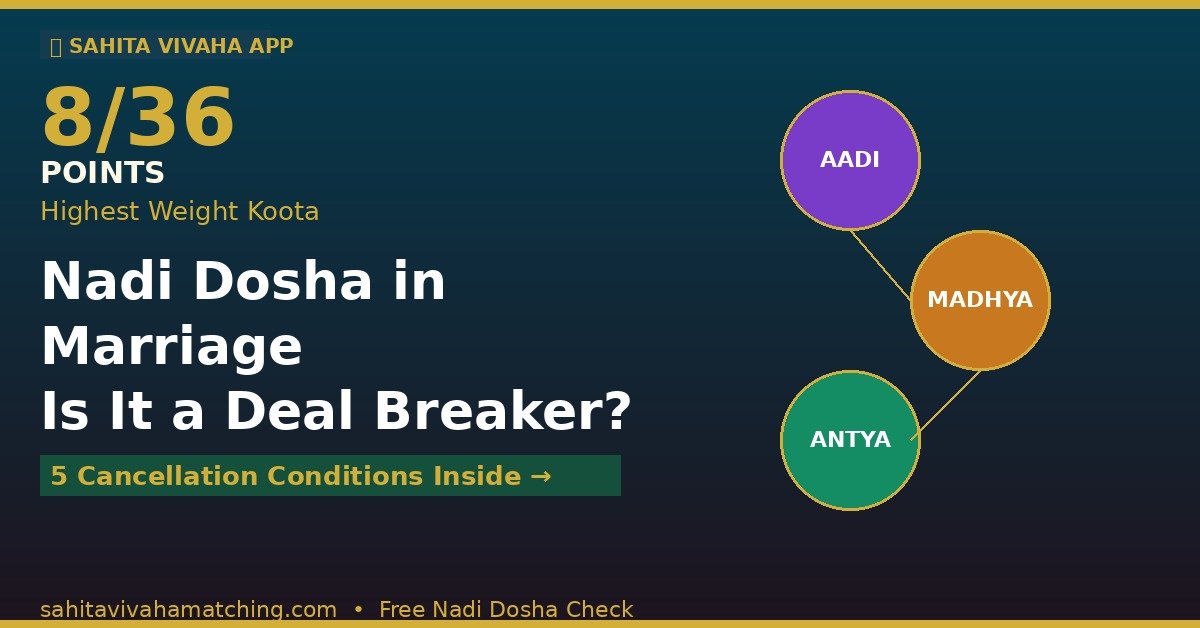
    Ask any astrologer which dosha concerns them most in a marriage match, and the answer is almost always the same: Nadi Dosha. It carries 8 out of 36 possible points in the Ashtakoota system — more than any other Koota — and when it scores 0, it can pull even a strong match below the recommended threshold.

    But Nadi Dosha is also one of the most misunderstood concepts in Vedic astrology. Here’s a clear, honest breakdown.

    What Is Nadi Dosha?

    Nadi Dosha occurs when both the bride and groom belong to the same Nadi — the same energetic constitution as determined by their birth Nakshatra.

    The three Nadis are:

    Nadi Element Constitution Nakshatras (examples)
    Aadi Nadi Vata (Wind) Thin build, restless, creative Ashwini, Ardra, Punarvasu, Uttara Phalguni, Hasta, Jyeshtha, Moola, Shatabhisha, Poorva Bhadrapada
    Madhya Nadi Pitta (Fire) Medium build, ambitious, intense Bharani, Mrigashira, Pushya, Poorva Phalguni, Chitra, Anuradha, Poorvashada, Dhanishtha, Uttara Bhadrapada
    Antya Nadi Kapha (Earth) Heavy build, stable, patient Krittika, Rohini, Ashlesha, Magha, Swati, Vishakha, Uttarashada, Shravana, Revati

    Why Does Same Nadi Create a Problem?

    Classical Vedic texts argue that same-Nadi couples share identical constitutional energies. This similarity is thought to create:

    • Poor physical compatibility and health problems in the couple
    • Difficulty conceiving children or issues with offspring’s health
    • In extreme interpretations — danger to one partner’s life

    The modern scientific parallel often cited is genetic compatibility: same constitution may increase the chance of passing similar genetic traits, potentially affecting offspring health. This remains speculative, but the traditional concern is real.

    How Common Is Nadi Dosha?

    Since each of the 27 Nakshatras belongs to one of three Nadis, statistically about 33% of random couples will share the same Nadi. This makes Nadi Dosha relatively common — which is why cancellation conditions are so important to check.

    Cancellation Conditions for Nadi Dosha

    Nadi Dosha is cancelled or significantly reduced in these situations:

    • Different Moon signs (Rashis): If both have the same Nakshatra but different Rashis, many texts consider the dosha cancelled
    • Same Nakshatra, different Pada (quarter): Some schools consider this a cancellation
    • Nakshatra lord is friendly or the same: Can reduce severity
    • Strong Jupiter in the 7th house: Benefic protection is considered a mitigating factor

    It’s critical to have a qualified astrologer check these conditions, because a rigid “same Nadi = no match” ruling may be unnecessarily rejecting a compatible couple.

    What to Do If Both Partners Have Nadi Dosha

    1. First verify cancellation conditions — consult a trusted Jyotishi
    2. Check the full chart for overall compatibility beyond Ashtakoota
    3. If proceeding, consider traditional remedies: Nadi Dosha Nivarana Puja, worship of Mahamrityunjaya Mantra, donation of gold, land, or cows
    4. Some texts recommend performing the marriage on a date with strong Chandra Bala (favorable Moon position)
    📱 Instantly Know Your Nadi Dosha Status
    Sahita App checks Nadi, Bhakoot, Mangal Dosha and all 8 Kootas — completely free. Available in Kannada, Hindi, Telugu, Tamil and more.
    Download Sahita Free →

    Frequently Asked Questions

    Is Nadi Dosha a dealbreaker for marriage?

    Not necessarily. Cancellation conditions must be checked first. If the Rashis are different, many classical texts consider the dosha nullified. Always consult a Jyotishi for a complete evaluation.

    Which is worse — Nadi Dosha or Mangal Dosha?

    Nadi Dosha is generally considered more serious as it carries 8 points (the highest in Ashtakoota) and relates to health and progeny. Mangal Dosha is more widely feared in popular culture but is often cancelled by various conditions.

    Can Nadi Dosha be removed by a puja?

    Classical texts prescribe Nadi Dosha Nivarana Puja as a remedy. While many families perform it for peace of mind, astrologers differ on how much it actually neutralizes the dosha versus formal cancellation conditions.

    Related Reading: Gun Milan Explained · Horoscope Matching for Marriage

  • Bhakoot Dosha in Kundali Matching: What It Is and When to Worry

    Bhakoot Dosha in Kundali Matching: What It Is and When to Worry

    In the 36-point Ashtakoota system, Bhakoot Koota carries 7 points — making it the second most weighted compatibility factor after Nadi. When Bhakoot Dosha is present and uncancelled, it gives 0 out of 7, a significant deduction that can bring a match’s total below 18.

    But is Bhakoot Dosha as serious as families fear? Here’s what you actually need to know.

    What Is Bhakoot Dosha?

    Bhakoot Dosha occurs when the Moon signs (Rashis) of the bride and groom fall in specific unfavorable combinations relative to each other. It is determined by counting the Rashis from one partner’s Rashi to the other’s.

    Which Rashi Combinations Create Bhakoot Dosha?

    Combination Rashi Distance Traditional Effect
    2–12 Bhakoot 2nd and 12th from each other Financial loss, poverty, family discord
    6–8 Bhakoot 6th and 8th from each other Health issues, accidents, short lifespan of partner
    5–9 Bhakoot 5th and 9th from each other Loss of children, unfortunate progeny — DISPUTED (some say auspicious)

    The 5–9 combination is actually considered auspicious by some astrological schools, and many modern astrologers do not count it as a dosha at all.

    Common Rashi Pairs That Create 6–8 Bhakoot Dosha

    • Aries (Mesh) – Scorpio (Vrishchik)
    • Taurus (Vrishabh) – Sagittarius (Dhanu)
    • Gemini (Mithun) – Capricorn (Makar)
    • Cancer (Kark) – Aquarius (Kumbh)
    • Leo (Simha) – Pisces (Meen)
    • Virgo (Kanya) – Aries (Mesh)

    Cancellation of Bhakoot Dosha

    Bhakoot Dosha is cancelled under several important conditions:

    • Both partners have the same Rashi lord (e.g., Aries and Scorpio are both ruled by Mars)
    • Both partners have Rashi lords that are friends
    • The Nadi Koota scores full points (8/8)
    • The Gana match is excellent (6/6)
    • Strong benefic planets in the 7th house of both charts

    In the case of Aries–Scorpio (6–8 dosha), both Rashis are ruled by Mars, so the dosha is automatically cancelled. Similarly, Gemini–Capricorn has this cancellation since Mercury and Saturn are considered neutral-to-friendly.

    How Seriously Should You Take Bhakoot Dosha?

    Classical texts like Muhurta Martanda consider Bhakoot one of three “Maha Doshas” (major doshas) along with Nadi and Gana. However, contemporary practice has evolved:

    • Many astrologers today consider Bhakoot less severe than Nadi Dosha
    • The dosha’s effects are often mitigated by strong Jupiter, Venus, or 7th house indicators in both charts
    • Real-world evidence shows many Bhakoot Dosha couples living harmonious lives

    The consensus: Always get cancellation conditions checked before rejecting a match purely on Bhakoot grounds.

    📱 Check Bhakoot Dosha Instantly with Sahita
    Sahita App calculates Bhakoot Dosha, checks all cancellation conditions, and gives you a clear verdict — free, in your language.
    Download on Google Play →

    Frequently Asked Questions

    Can a couple with Bhakoot Dosha have a happy marriage?

    Yes — especially when cancellation conditions apply or when the overall chart analysis is positive. Many couples with Bhakoot Dosha live happily together.

    Is 6–8 Bhakoot Dosha worse than 2–12?

    Both are serious, but 6–8 is generally considered more severe as it affects health and longevity. The 2–12 combination primarily affects finances and family harmony.

    Should I consult an astrologer for Bhakoot Dosha?

    Yes — especially if the overall Ashtakoota score is already below 20. A qualified Jyotishi can evaluate cancellation conditions and provide a balanced assessment.

  • Mangal Dosha: Effects, Remedies and What Every Indian Must Know Before Marriage

    Mangal Dosha: Effects, Remedies and What Every Indian Must Know Before Marriage

    Of all the concepts in Vedic astrology that come up during marriage discussions, Mangal Dosha is the most feared — and the most misunderstood. Families cancel proposals when they hear the word “Manglik,” yet many astrologers say the reality is far less alarming than the myth.

    Here is everything you need to know about Mangal Dosha — what it actually means, how it affects married life, and how to address it.

    What Is Mangal Dosha?

    Mangal Dosha (also called Kuja Dosha or Manglik Dosha) occurs when Mars (Mangal) is placed in certain houses in a birth chart. Mars is a fiery, aggressive planet. When it occupies specific houses related to marriage, it is believed to bring conflict, separation, or in extreme cases, danger to the spouse.

    Which Houses Create Mangal Dosha?

    Mars placed in any of these houses in the Lagna (Ascendant) chart creates Mangal Dosha:

    House Reason for Concern
    1st House (Lagna) Mars aspects the 7th house of marriage
    2nd House House of family — Mars creates speech issues and family conflict
    4th House House of domestic happiness — Mars disrupts home peace
    7th House Directly in the house of marriage — strongest Mangal Dosha
    8th House House of longevity of spouse — most feared placement
    12th House House of bed pleasures — Mars causes relationship issues

    Note: Some schools of thought include only 1, 2, 4, 7, 8, 12. Others check from Moon and Venus charts too.

    How Common Is Mangal Dosha?

    Mars occupies one of the six dosha-forming houses roughly 40–50% of the time. This means nearly half the population technically has some form of Mangal Dosha — which is why astrologers say the dosha has been overstated in popular culture.

    Mangal Dosha Cancellation Conditions

    Many birth charts have conditions that cancel or neutralize the dosha:

    • Mars is in its own sign (Aries or Scorpio) or exalted (Capricorn)
    • Mars is aspected by benefic planets like Jupiter or Venus
    • Mars is in the 7th or 8th house of Scorpio (own sign)
    • Both partners have Mangal Dosha (mutual Mangal Dosha cancels the effect)
    • Person was born on Tuesday (partial mitigation)
    • The Lagna or Moon sign is Aries or Scorpio (Mars-ruled)

    Effects of Mangal Dosha on Marriage

    Traditional astrology associates Mangal Dosha with:

    • Frequent arguments and conflict with spouse
    • Delay in marriage
    • Separation or divorce
    • In severe cases (especially 8th house Mars), danger to the partner’s life

    However, modern astrologers caution that these are potential tendencies — not certainties. The full chart must be analyzed holistically.

    Remedies for Mangal Dosha

    If Mangal Dosha is confirmed and not cancelled, these remedies are commonly prescribed:

    1. Marrying a Manglik partner: The most accepted remedy — mutual dosha cancels the effect
    2. Kumbh Vivah: A symbolic marriage ritual with a banana tree or Vishnu idol before the actual wedding
    3. Mangal Puja: Worship of Mars on Tuesdays with red flowers and prayers
    4. Wearing Red Coral: Mars’s gemstone worn in gold or copper after expert advice
    5. Hanuman Puja: Tuesday visits to Hanuman temples are considered effective
    📱 Check Mangal Dosha Free with Sahita App
    The Sahita app automatically checks Mangal Dosha in your birth chart and your partner’s — with full explanation. Available in Hindi, Kannada, Telugu, Tamil and more.
    Download Free on Google Play →

    Frequently Asked Questions

    Is it safe to marry a Manglik person?

    Yes — especially if the partner is also Manglik, or if cancellation conditions apply. Many Manglik individuals lead happy married lives. Consult a trusted astrologer for a complete assessment.

    Does Mangal Dosha affect love marriages?

    The dosha is in the birth chart regardless of the type of marriage. However, if a couple has been in a relationship for years without conflict, astrologers may weigh this evidence alongside chart analysis.

    Can Mangal Dosha be fully removed?

    Astrologers say remedies reduce the malefic impact but the dosha itself remains in the chart. Marrying a fellow Manglik is considered the most effective neutralization.

    Related Reading: Horoscope Matching for Marriage · Gun Milan & Ashtakoota System