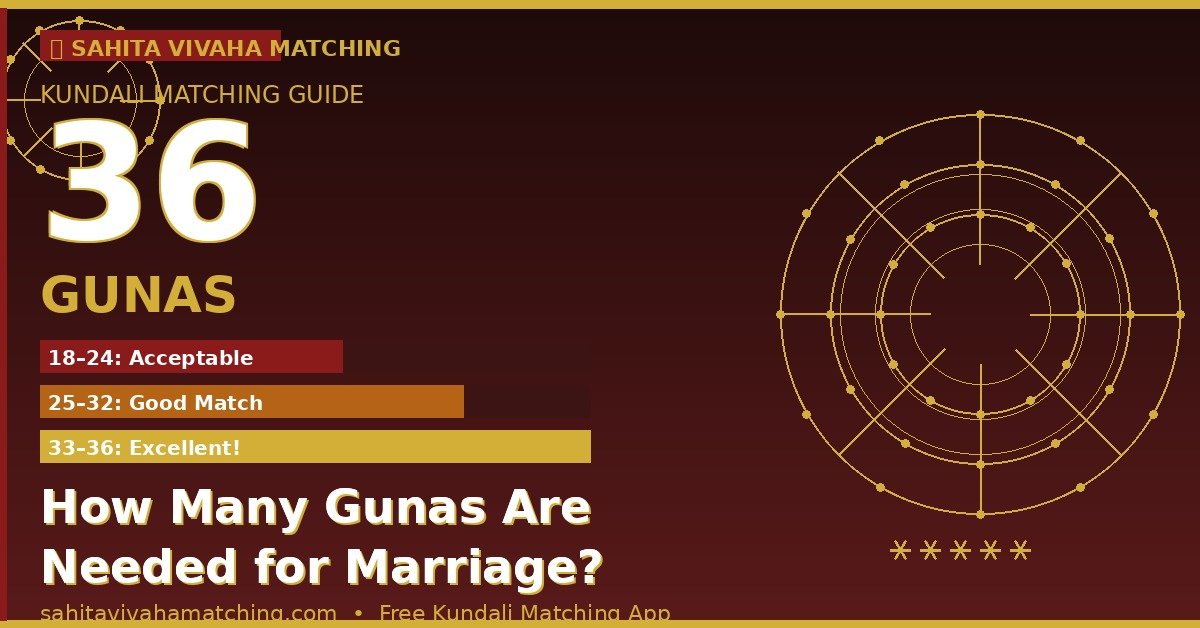
How many gunas for marriage? A minimum of 18 out of 36 gunas must match for a marriage to be approved in Vedic astrology. Scores of 18–24 are acceptable, 25–32 are considered very good, and 33–36 are rare and excellent. Below 18, classical astrologers advise against the match unless specific doshas are cancelled or remedied. This is the rule followed across India — in kundli milan, janmakshar matching, jataka porutta, and koshthi milan alike — and it comes from the Ashta Koota system codified in classical texts.
But the total score is only half the story. Two matches can both score 22 and have completely different prospects — because which gunas failed matters more than how many. This guide covers the minimum score, every score band from 0 to 36 with its verdict, which of the eight kootas carry the real weight, and the classical exceptions that can approve a low-scoring match. You can verify everything in this article against your own free 36 Guna report from the Sahita Vivaha Matching app.
How Many Gunas for Marriage: The Quick Answer
When elders ask how many gunas for marriage should match, they are referring to the Vedic system that scores marriage compatibility out of 36 points across eight tests called kootas — this is the Ashta Koota Milan system, attributed to the sage Parasara. The traditional verdict bands are:
| Guna Score | Traditional Verdict | Marriage Recommendation |
|---|---|---|
| 0 – 17 | Ati-Nyoon (insufficient) | Not recommended without dosha cancellation or remedies |
| 18 – 24 | Madhyam (average) | Acceptable — proceed after checking which kootas failed |
| 25 – 32 | Uttam (very good) | Recommended — green light in most families |
| 33 – 36 | Atyuttam (excellent) | Rare and considered highly auspicious |
The 18-point threshold is the answer elders across India are looking for when they ask “kitne gun mile?” — because when families ask how many gunas for marriage are required, 18 of 36 means half the compatibility dimensions align, which classical tradition treats as the minimum viable foundation for a marriage.
Every Guna Score From 0 to 36: The Complete Verdict Table
Asking how many gunas for marriage is enough only gets you the 18-point rule — but people rarely score exactly on a band boundary, so here is the verdict for every possible score. Find your exact number from your 36 Guna report:
| Your Score | Verdict | What It Means for Your Marriage |
|---|---|---|
| 0 – 9 | Very poor | Fundamental mismatches across most dimensions. Traditional astrologers will not approve. If you wish to proceed, a full Navamsa analysis and remedies for each failing koota are essential. |
| 10 – 13 | Poor | Fewer than 40% of compatibility points align. Check whether a single heavy koota (Nadi 8 pts, Bhakoot 7 pts) is dragging the score — its cancellation could change the verdict entirely. |
| 14 – 17 | Below threshold | Close to acceptable but short of the classical minimum. Very often one cancelled dosha lifts these matches over 18. Have the cancellations checked before deciding. |
| 18 | Minimum pass | The classical gate. Marriage is permissible. Look at WHICH kootas failed — an 18 missing Nadi (8 pts) needs more attention than an 18 missing several small kootas. |
| 19 – 21 | Fair | Workable match. The couple will need mutual effort in the areas flagged by failing kootas — typically temperament (Gana) or daily influence (Vashya). |
| 22 – 24 | Good | Above-average compatibility. Most astrologers approve comfortably at this range provided Nadi and Bhakoot are clean or cancelled. |
| 25 – 28 | Very good | Strong alignment across most dimensions of married life. This is the range most families are happy with. |
| 29 – 32 | Excellent | Exceptional compatibility. Approvals are near-automatic. Verify Manglik status separately — a high guna score does not cancel Mangal Dosha. |
| 33 – 35 | Outstanding | Rare. Almost every dimension aligns. Traditionally celebrated as a destined match. |
| 36 | Perfect | All eight kootas align fully — statistically rare. Note: even 36/36 does not guarantee success; Lord Rama and Sita are traditionally said to have scored 36. Navamsa and Manglik checks still apply. |
Real-world proof that the number is not destiny: read the story of a couple who matched 36/36 and still divorced, and the opposite case — what happened when a couple matched only 14 gunas. The score opens or closes the conversation; the koota detail tells you what the marriage will actually need.
Where the 36 Gunas Come From: The 8 Kootas and Their Weights
The 36 points are not distributed evenly. Each koota tests one dimension of married life, and the point values rise with importance:
| Koota | Points | What It Tests | Share of Total |
|---|---|---|---|
| Varna | 1 | Spiritual class compatibility | 2.8% |
| Vashya | 2 | Mutual influence and attraction | 5.6% |
| Tara | 3 | Health and well-being | 8.3% |
| Yoni | 4 | Physical and instinctual harmony | 11.1% |
| Graha Maitri | 5 | Mental compatibility, friendship of moon lords | 13.9% |
| Gana | 6 | Temperament (Deva / Manushya / Rakshasa) | 16.7% |
| Bhakoot | 7 | Family harmony and finances | 19.4% |
| Nadi | 8 | Health of progeny, genetic compatibility | 22.2% |
Notice that Nadi and Bhakoot together control 15 of the 36 points — over 41% of the entire score. This is why a single Nadi Dosha (0/8 on Nadi) can pull an otherwise excellent match below the 18-point threshold, and why checking Nadi Dosha cancellation rules and Bhakoot Dosha cancellations matters more than any other single step in guna matching. A full breakdown of all eight tests is in our 36 Guna Milan explained guide.
Is 18 Gunas Enough for a Good Marriage?
Yes — 18 gunas is classically sufficient, but with a condition most online tools skip: the 18 must not include an uncancelled Nadi or Bhakoot dosha. An 18-point match with clean Nadi and Bhakoot is a normal, approvable match. An 18-point match where Nadi scored zero without cancellation is a different situation entirely, and most classical astrologers will treat it as a failing match despite the passing total.
This is the single most misunderstood point in guna matching, and it is why two families with the same score can receive opposite advice from their astrologers. When your report lands between 18 and 24, always ask: which kootas failed, and do classical cancellations apply? A proper matching tool applies these cancellation rules automatically — the free Sahita report shows each koota’s score with its cancellation status, so you see the real picture rather than a bare number.
Can We Marry With Less Than 18 Gunas?
Classically, a below-18 match is not approved — but tradition provides three recognised paths forward, in order of astrological weight:
- Dosha cancellation (best case). Recompute the score after checking the classical exceptions. Nadi Dosha alone has five cancellation rules — same nakshatra different pada, same nadi but different rashi, and specific nakshatra pairings. A cancelled dosha restores its full points; many “16-point” matches are actually 24-point matches once cancellations are applied.
- Navamsa (D9) analysis. The Navamsa chart is the divisional chart astrologers read specifically for marriage. Strong 7th-house placements and a well-placed Venus (for the groom) or Jupiter (for the bride) in Navamsa can support a marriage the guna count alone would reject. Couples in this real story of marrying against the astrologer’s verdict relied on exactly this second-level analysis.
- Remedial measures. For doshas that are genuine and uncancelled, tradition prescribes remedies: Kumbh Vivah for Manglik mismatch, targeted graha-shanti pujas for Nadi and Bhakoot, and mantra japa for weaker kootas. These are documented practice across centuries — discussed honestly in our guide on whether you can marry when the kundali does not match.
Does a High Guna Score Guarantee a Successful Marriage?
No — and classical astrology never claimed it did. The guna count is a screening tool that checks natal compatibility across eight dimensions. Three things sit outside it entirely:
- Manglik Dosha is checked separately from the 36 gunas. A 30-point match where one partner is Manglik and the other is not still carries the Mangal mismatch — check both partners with a free Manglik check alongside the guna score.
- Navamsa strength shows marriage-specific dynamics that the rashi-level guna count can mask — a weak D9 undermines a high guna total, and a strong D9 can carry a modest one.
- Dasha timing determines when the marriage happens and which planetary periods the couple will pass through together — a factor the guna count does not see at all.
This is why experienced astrologers describe guna milan as necessary but not sufficient: pass the 18-point gate, clear Nadi and Bhakoot, then confirm Manglik and Navamsa. That full sequence — not the guna count alone — is the classical standard for approving a marriage. For how app-generated scores compare with a family astrologer’s reading, see why app scores and astrologer scores sometimes differ.
How Guna Matching Differs Across India
The 36-guna Ashta Koota system dominates North, West, and East India, but South Indian families often use a different framework — the 10 Porutham method, which tests ten compatibility factors rather than eight and does not produce a 36-point score. Tamil, Malayalam, and some Kannada and Telugu traditions follow Porutham; many South Indian families today run both systems and compare. The methods agree more often than they disagree, since both are built on nakshatra compatibility. Our comparison of 10 Porutham vs 36 Guna covers where the two systems align and where they diverge.
Whichever system your family follows, the inputs are identical — name, date of birth, time of birth, and place for both partners — and the kundali matching for marriage process takes under a minute with a modern tool. If the birth time is unknown, a partial match is still possible: see kundali matching without birth time.
How to Check Your Guna Score Free (60 Seconds)
- Collect four details for each partner: full name, date of birth, exact time of birth, place of birth.
- Open the Sahita Vivaha Matching app — free on Google Play, no login, no ads, no astrologer upsell.
- Enter both partners’ details. The app computes all eight kootas with individual scores.
- Read the total against the verdict table above — and check each failing koota’s cancellation status, which the report shows automatically.
- Share the report as a PDF with your family in any of eleven Indian languages — English, Hindi, Kannada, Telugu, Tamil, Marathi, Malayalam, Gujarati, Bengali, Odia, or Punjabi.
Frequently Asked Questions
How many gunas for marriage are minimum?
The answer to how many gunas for marriage: 18 out of 36 minimum. Below 18 gunas, Vedic astrology does not recommend the match unless the failing doshas are classically cancelled or remedied. Between 18 and 24 is acceptable, 25 to 32 is very good, and 33 to 36 is considered excellent.
Is 20 gunas a good match?
Yes — 20 out of 36 passes the classical minimum of 18 and sits in the “fair” band. Check which kootas failed: if the missing points come from small kootas (Varna, Vashya, Tara), the match is comfortable; if Nadi (8 points) is the failure, verify its cancellation rules before proceeding.
Is 28 out of 36 gunas good for marriage?
Yes — 28 is in the “very good” band (25–32). Most astrologers approve at this level without hesitation, provided the Manglik status of both partners is also compatible, which is checked separately from the guna score.
Can marriage happen with 16 gunas?
Classically not recommended at face value — but a 16 often becomes 24 once dosha cancellations are applied, because a cancelled Nadi Dosha restores 8 points. Have the cancellation rules checked before treating 16 as final. If the dosha is genuine, Navamsa analysis and remedies are the traditional paths.
Which guna is most important in matching?
Nadi, worth 8 of the 36 points — the highest single weight, associated with progeny and health compatibility. Bhakoot (7 points, family and finances) is second. Together they control over 41% of the total score, which is why their doshas and cancellations decide most borderline matches.
Is guna matching free online accurate?
The calculation itself is deterministic — any correctly built tool using precise ephemeris data produces the same koota scores an astrologer computes by hand. Accuracy differences come from input errors (wrong birth time) and from tools that skip cancellation logic. Use a tool that shows per-koota scores and cancellation status, not just a total.
The Bottom Line
Eighteen of thirty-six gunas is the classical minimum for marriage — but the wise reading goes one level deeper: clear or cancel Nadi and Bhakoot, confirm Manglik compatibility for both partners, and let the Navamsa have the final word on borderline scores. That is the complete, honest answer to how many gunas for marriage are truly needed.
Your own score, with all eight kootas, cancellation checks, and Manglik status for both partners, takes less than a minute:
Related reading: Kundali matching score meaning — 0 to 36 guide · 36 Guna Milan explained — all 8 kootas · We matched 32/36 and still couldn’t make it work